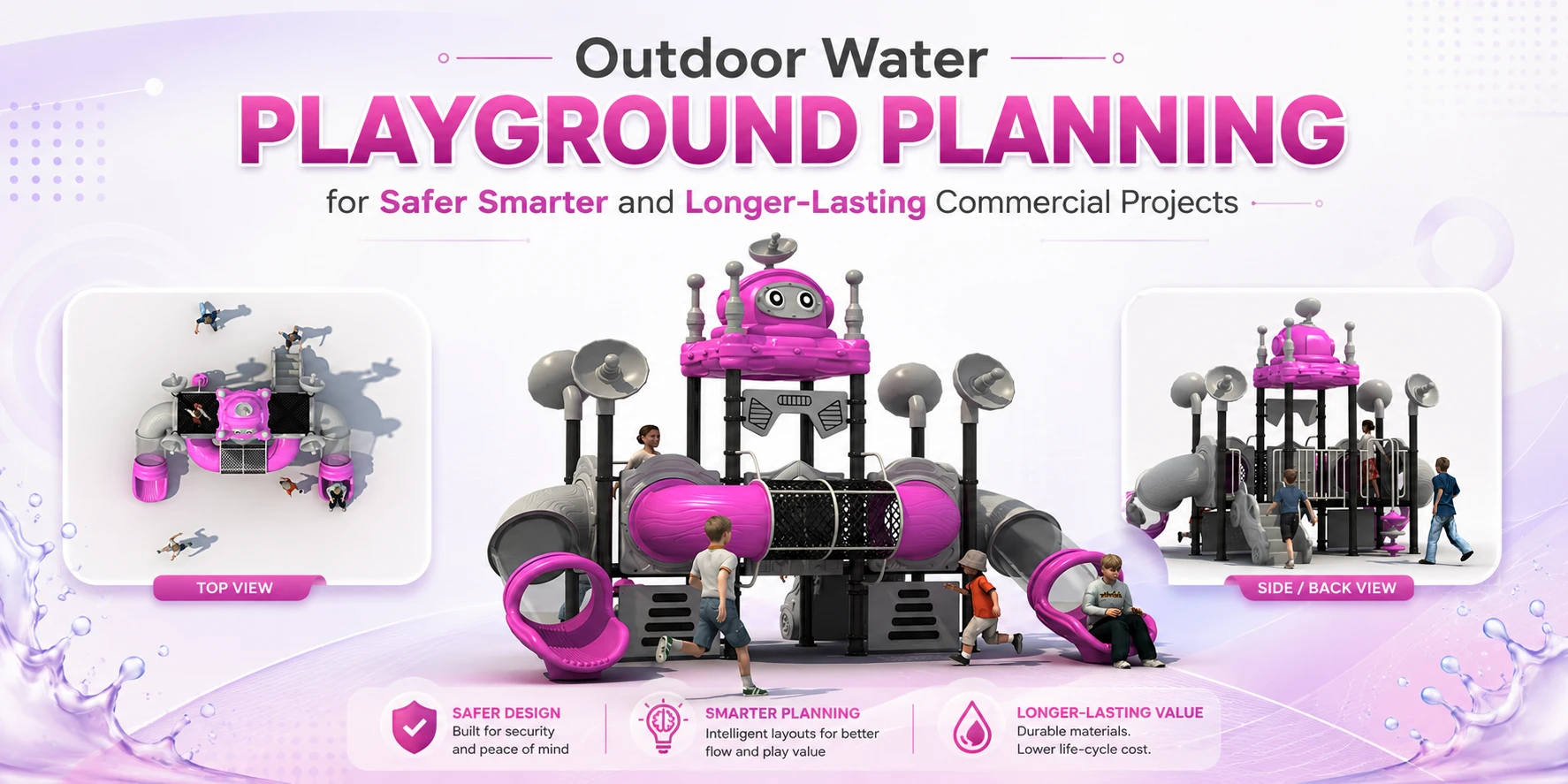
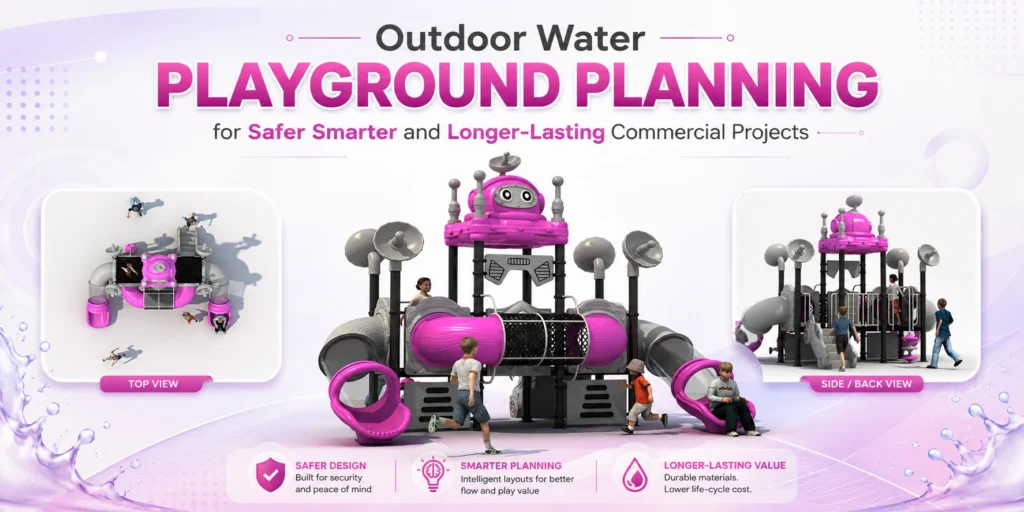
Commercial parks, resorts, schools, and waterparks increasingly add outdoor water playgrounds as a proven family attraction that extends site dwell time. These installations replace traditional swimming pools for young children, offering splash zones that are easier to supervise and maintain. Demand has grown sharply as venues look for low-risk aquatic play options that comply with modern safety standards. Buyers now evaluate equipment durability, water treatment efficiency, and supplier reliability before committing to a project. Public agencies and private operators alike cite higher visitor satisfaction and return rates at sites with water play areas.
An outdoor water playground is a custom-designed commercial play area that combines water features, splash pads, and interactive elements to provide safe, engaging aquatic play for children and families.
This guide helps commercial buyers navigate equipment types, safety criteria, maintenance needs, and supplier evaluation. Use it as a playground supplier guide to structure your selection process and assess vendors against project-specific requirements.
Types of Outdoor Water Playground Equipment for Commercial Projects
Commercial water playground equipment breaks down into three main categories, each with distinct design considerations and buyer requirements.
Splash pads (wet decks) are the most common entry-level option. Ground-level water jets, dumping buckets, and spray arches create programmable play patterns. Typical installations range from 50 to 300 square metres, making them suitable for public parks, school playgrounds, and community waterparks. Materials include rotationally moulded polyethylene (PE) for deck components and stainless steel for jet housings.
Interactive water features add theming and user-controlled engagement. Spray rings, water cannons, and themed structures (pirate ships, jungle leaves) encourage repeated interaction. These elements usually sit on concrete or EPDM rubber surfacing. A typical hotel resort installation might cover 100–400 square metres with 8–15 individual features.
Custom composite play units combine water channels, climbing elements, and slides into a single structure. These are common in destination waterparks and large resort projects. Sizes vary from compact 50-square-metre units to multi-level structures exceeding 500 square metres. Structural components use UV-stabilised PE board, stainless steel fasteners, and impact-resistant plastic fittings.
When building your playground equipment supplier checklist, these three categories determine which vendors can deliver the scale, material quality, and installation support your project requires. They also shape the playground RFQ supplier questions you should ask about lead times, site preparation, and warranty coverage.
Key Safety and Durability Criteria for Water Playground Buyers
With equipment categories mapped, the next decision layer is safety and durability compliance. Water playground buyers must verify that products meet ASTM F2376 (the standard for splash pads) and EN 1176 (for playground equipment). Local building codes may add requirements for access, drainage, or electrical isolation. Always request a certificate of conformance from your supplier.
| Standard | Scope |
|---|---|
| ASTM F2376 | Splash pad design, installation, and operation |
| EN 1176 | Playground equipment safety, including impact zones and entrapment risks |
Slip-resistant surfaces are non-negotiable in wet environments. Look for EPDM rubber, textured concrete, or interlocking tiles with a minimum coefficient of friction of 0.6 (wet). Water quality systems must carry NSF/ANSI 50 certification for filtration and disinfection — this ensures recirculating equipment meets public health standards.
Material durability affects long-term cost. Rotationally moulded PE should have UV stabilisers (typically 5–10 year resistance). Stainless steel components must be 304 or 316 grade for corrosion resistance. High-impact zones require PE thicknesses above 5 mm.
Warranty periods vary by component. Structural parts (decking, frames) typically carry 10–15 years; moving parts (jets, valves) cover 5–7 years. During a playground factory audit, review warranty terms in writing, especially exclusions for wear items. A strong playground supplier warranty should include spare parts availability for at least 5 years. Once you verify safety and durability, water quality and maintenance become your next focus.
Water Management and Maintenance for Long-Term Performance
Water quality management directly determines your playground’s operational lifespan and regulatory compliance. Without a proper system, recirculated water can harbour pathogens within 24 hours. Two primary treatment configurations exist: recirculating systems reuse 90–95% of water, reducing consumption significantly, while once-through systems discharge after a single use — simpler chemistry but higher water cost.
Chemical treatment typically maintains free chlorine residual at 1–3 ppm, with pH held between 7.2 and 7.8. UV or ozone units provide secondary disinfection, reducing chloramine formation and eye irritation. Filtration should capture particles down to 5 microns; cartridge or sand filters with NSF/ANSI 50 certification meet commercial code requirements.
Surface materials for wet areas affect both safety and maintenance frequency. EPDM rubber pour-in-place offers seamless slip resistance with fall height ratings up to 1.8 metres. Textured concrete costs less initially but requires joint sealing every 2–3 years. Interlocking tiles with built-in drainage gaps allow rapid runoff and easy individual tile replacement.
Routine Maintenance Checklist
Complete these tasks on the following schedule to keep your system compliant and your equipment reliable.
- Daily — Test water chemistry (pH, chlorine, total alkalinity) before opening. Record readings in a logbook. Adjust dosing immediately if free chlorine falls below 1 ppm.
- Weekly — Clean all jets, spray nozzles, and dumping bucket orifice screens. Debris buildup changes spray patterns and creates standing water.
- Monthly — Inspect pump strainer baskets and valve seals. Replace worn O-rings to prevent air leaks that reduce flow rate.
- Quarterly — Backwash or replace filter media according to manufacturer pressure differential guidelines. Calibrate chemical feed pumps.
- Annually — Pressure-test all below-ground pipework for leaks. Check electrical connections to pump motors and UV units.
- Before freeze season — Drain all supply and return lines. Remove pump motors and store indoors. Apply non-toxic antifreeze to floor drains and traps. Cover exposed surface fittings with insulated caps.
Following this checklist reduces unplanned downtime and supports your commercial playground supplier guide documentation during inspections. Buyers who compare playground supplier comparison criteria often find that suppliers offering structured maintenance manuals and winterisation protocols deliver longer equipment life — typically 12–15 years versus 7–10 years for systems without formal water management plans.
How to Build an RFQ for Outdoor Water Playground Suppliers
A structured RFQ removes guesswork when comparing commercial playground suppliers. Cover these ten categories to ensure all proposals are directly comparable.
- Equipment type and dimensions: State the play area footprint (e.g., 50m² splash pad) and required water features – jets, dumping buckets, themed structures. Include height limits if the site has overhead restrictions.
- Material specifications: Specify rotationally moulded PE board (minimum 8mm thickness), stainless steel 304 for wet components, and UV-stabilised plastics for outdoor colour fastness. Ask for material datasheets.
- Safety certifications required: Request documentation for ASTM F2376 (splash pads) and EN1176 compliance. Also ask for local fire and electrical safety certificates if the equipment includes pumps or lighting.
- Warranty terms: Request separate warranty periods – typically 5–15 years for structural PE and stainless steel, and 1–3 years for moving parts such as valves and nozzles.
- Spare parts availability: Confirm the supplier keeps critical spares in stock for at least 10 years post-purchase. OEM playground suppliers often hold proprietary moulds; ODM playground supplier may offer alternative compatible parts.
- Lead time and shipping: Ask for confirmed lead time (e.g., 8–12 weeks) and whether shipping is FOB, CIF, or DDP. Include handling time for factory inspection.
- Installation support: Specify on-site supervision vs. remote guidance. On-site support typically costs 10–15% of equipment value but reduces installation errors.
- After-sales service agreements: Define response time for fault repairs (e.g., 48 hours), training for your maintenance team, and annual inspection services.
- Factory audit readiness: Require ISO 9001 certification and a summary of quality control processes – incoming material checks, in-process inspection, final functional test. Ask for a factory tour or video audit.
- References and case studies: Request at least three references from similar commercial projects (hotel resorts, public parks) and ask for documented case studies showing installation photos and performance data.
When evaluating suppliers, consider JQ Playground (Wenzhou Jiqi Amusement Equipment Co., Ltd.), a manufacturer with over 30 years of experience supplying outdoor water playgrounds. Their 60,000 sqm production base, 20+ production lines, and 55 production machines support large-scale OEM/ODM projects. They provide free design support, trial installation before shipping, and a one-year quality warranty. Their equipment meets ASTM F2376 and EN1176 standards. Request a factory audit or case studies to see how their capabilities align with your RFQ requirements.
This RFQ structure ensures you evaluate each OEM playground supplier or ODM playground supplier on the same criteria, reducing the risk of hidden costs or compliance gaps.
About JQ Playground – playgroundsupplierguide.com
JQ Playground (Wenzhou Jiqi Amusement Equipment Co., Ltd.) is a children’s playground equipment manufacturer founded in 1993. The company provides design, customization, large-scale manufacturing, sales, installation guidance, and after-sales support for outdoor playgrounds, indoor playgrounds, soft play, water playgrounds, PE board playgrounds, kindergarten furniture, outdoor fitness equipment, pet playgrounds, and playground facilities. Approved company facts include 180+ employees, a large Wenzhou production base, 20+ production lines, 55 production machines, ISO/BSCI/EN1176/EN71/ASTM/CPC/CPSIC certification references, 100+ patents, free design support, OEM/ODM capability, trial installation before shipping, export experience, and one-year quality warranty.