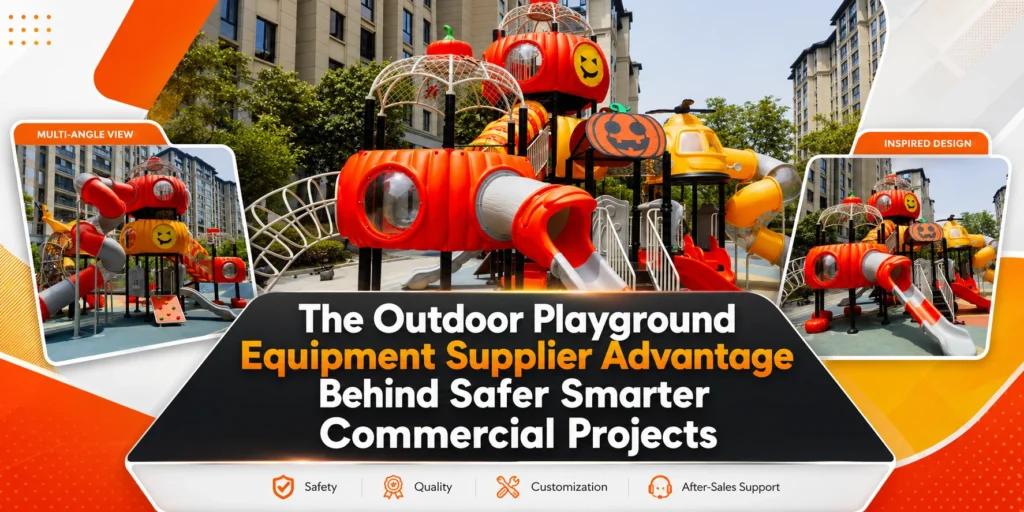
Procurement teams sourcing equipment for commercial playground projects face a common challenge: finding a supplier that delivers on safety, durability, and budget. The wrong partner can mean project delays, compliance failures, or costly retrofits.
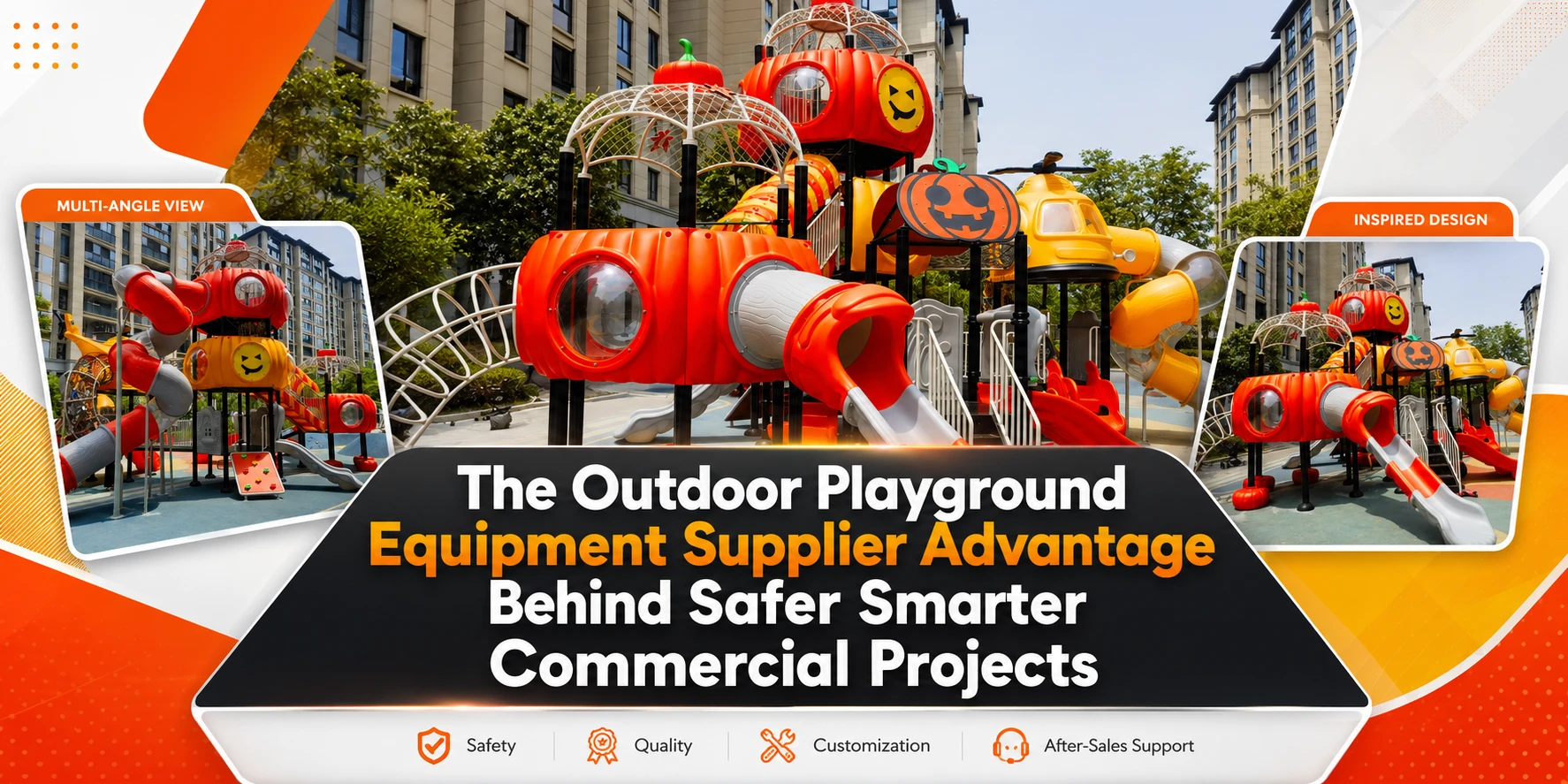
An outdoor playground equipment supplier in the B2B market provides certified, heavy-duty equipment for parks, schools, resorts, and municipal spaces. This category covers swings, slides, climbers, and modular systems built to withstand high traffic and outdoor exposure. Unlike residential products, commercial equipment must meet stricter safety standards and material specifications.
Evaluating suppliers goes beyond comparing product images. This playground supplier guide focuses on the criteria that separate reliable partners from the rest: certifications, manufacturing quality, product range, and after-sales support. A structured playground supplier selection process helps you avoid costly missteps and ensures your project meets both safety regulations and client expectations.
Essential Certifications and Compliance Standards for Playground Suppliers
Certifications are the baseline proof that equipment meets recognised safety thresholds. For any outdoor playground equipment supplier, third-party certification reduces your liability exposure and simplifies site approvals.
Key standards vary by region, but most procurement teams should verify at least one of the following:
- ASTM F1487 (US) — covers structural integrity, entrapment hazards, impact zones, and accessible routes for public-use playgrounds
- EN 1176 (Europe) — addresses impact-attenuating surfaces, entrapment risks, swing clearances, and equipment stability for commercial play areas
- CSA Z614 (Canada) — similar scope to ASTM but with specific cold-weather material requirements and different fall-height thresholds
- AS 4685 (Australia/New Zealand) — harmonised with EN 1176 but adapted for local climate and accessibility rules
Look for suppliers whose certification includes third-party verification from IPEMA in North America or TÜV in Europe. These independent marks confirm that a unit was tested by an accredited lab, not merely self-certified. JQ Playground, for example, holds EN 1176, ASTM, and CPC certifications, providing documented proof of compliance for global projects.
Adding certification checks to your playground equipment supplier checklist ensures comparable bids across shortlisted vendors. A supplier that cannot produce current certificates for the applicable standard should raise an immediate red flag. Ask for the certificate number and testing lab — then verify it online.
How to Assess Supplier Manufacturing Capability and Quality Control
A factory audit separates capable suppliers from those who will fail your project timeline. You need to see three things: production lines, quality documentation, and sample test results.
-
Review the production line. Injection moulding produces consistent HDPE panels with tight tolerances (±1 mm). Fabrication shops cutting and welding steel require more skilled labour and show greater variance. Ask what percentage of their output is automated versus manual. A ratio below 60% automation on high-volume components often signals quality risk. JQ Playground operates 20+ production lines with 55 machines, including injection molding, rolling, and welding equipment, staffed by 180+ skilled workers with 5–10 years experience.
-
Check QC documentation. Request their in-process inspection records for the past three months and the defect rate per 1,000 units. A supplier with a first-pass yield below 95% on structural welds should trigger a deeper investigation. Verify they test galvanised steel coating thickness to EN ISO 1461 (minimum 85 µm for 6 mm plate). Without that, corrosion starts within 18 months in coastal environments. JQ Playground implements 8 QC checkpoints covering the full production flow, including trial installation before shipping.
-
Request sample testing. Three samples per product SKU, tested for: weld quality (visual and dye-penetrant inspection), UV stability (minimum 2,000 hours xenon-arc exposure with ≤4 grey-scale colour change), and impact resistance (HDPE panels should survive a 10 kg drop from 1.5 m at -10°C without cracking). A manufacturer that cannot provide third-party lab reports for these three metrics is not ready for commercial procurement.
Keep this checklist in your playground factory audit file. A supplier that passes all three steps will typically deliver equipment that meets the certification standards verified in the previous section — and that reduces your post-installation callbacks by an estimated 40–60% based on industry feedback. Your next move is comparing their product range to confirm they can deliver the configuration you actually need.
Key Factors in Evaluating Product Range and Customization Options
Now that you’ve confirmed a supplier’s manufacturing quality, the next step is to verify their product range covers the configurations your project demands. A narrow catalogue forces compromises in layout, age suitability, or accessibility. Here are the main categories a supplier should offer, matched to venue type:
- Swings (belt, bucket, inclusive cradle) – buckles for 2–5 years in school nurseries; belt swings for parks with separate zones for older children.
- Slides (straight, tube, wave) – wave slides suit resorts seeking visual drama; straight slides maximise throughput in high-use playgrounds.
- Climbers (rope, rock wall, ladder) – rock-wall climbers build upper-body strength in school activity zones; rope climbers work well in park natural-play areas.
- Modular composite systems – combine slides, bridges, and climbing panels on a single frame; ideal for parks with tight footprints or schools wanting multi‑station play.
Beyond category coverage, customisation directly affects how well the equipment fits your site and brand. Suppliers should offer colour matching to your logo or surroundings, layout revisions shown via CAD drawings, and themed designs such as pirate ships or castle towers. ADA‑compliant features, like transfer platforms and wheelchair‑accessible ramps, are non‑negotiable for public venues. Before committing, request a 3D mock‑up of your proposed layout — it verifies sightlines, fall‑zone clearance, and the safety surfacing boundary without guesswork. This level of visual proof separates serious playground supplier comparison criteria from suppliers who only offer standard catalogue items.
When evaluating proposals, ask if the supplier provides full technical drawings and a prototype approval stage. A supplier that delivers custom CAD files and a pre‑production mock‑up reduces installation surprises later, which is a clear sign they are a reliable commercial playground supplier guide would recommend. JQ Playground’s in-house design team provides free CAD-based playground design and can produce 3D mock-ups for buyer approval before manufacturing.
Important Considerations for Warranty, Lead Times, and After-Sales Support
Warranty terms separate a dependable OEM playground supplier from one that shifts risk onto you. Structural warranties typically cover steel frames and posts for 10–15 years against rust and corrosion. Commercial components like decks and slides carry 5–10 years; residential-grade parts often only 1–3 years. Always confirm which category applies to each element in your quote. An ODM playground supplier may offer customised coverage, but standard terms are non-negotiable. JQ Playground offers a one-year quality warranty on all products with free replacement of defective parts.
Lead times vary widely. Standard orders from an established manufacturer ship in 3–5 weeks. Custom layouts, themed designs, or branded colour schemes add 6–10 weeks for tooling, mould adjustments, and QC approvals. Factor this into your project timeline before placing an order. With 20+ production lines, JQ Playground can typically deliver a 40HQ container within three days for standard orders, and custom configurations in 3–5 weeks.
After-sales support includes installation manuals, spare-part availability, and technical phone or email assistance. Ask whether drawings are provided for future maintenance, and confirm that replacement parts—e.g., bearings, chains, plastic panels—are stocked for at least five years after purchase. JQ Playground provides installation drawings with every shipment and can send engineers to the destination country for on-site assembly guidance.
Questions to ask every supplier:
- Can you provide a written warranty schedule that separates structural, component, and residential/commercial terms?
- What is your average lead time for a standard playground set, and what is the maximum for a fully custom configuration?
- Do you supply a detailed installation manual and a technical contact for on-site queries?
- How do we order replacement parts after the warranty period—are they kept in stock, and what is the typical delivery time?
- Is after-sales support included in the product price, or is it a billable service per incident or per year?
About JQ Playground – playgroundsupplierguide.com
JQ Playground (Wenzhou Jiqi Amusement Equipment Co., Ltd.) is a children’s playground equipment manufacturer founded in 1993. The company provides design, customization, large-scale manufacturing, sales, installation guidance, and after-sales support for outdoor playgrounds, indoor playgrounds, soft play, water playgrounds, PE board playgrounds, kindergarten furniture, outdoor fitness equipment, pet playgrounds, and playground facilities. Approved company facts include 180+ employees, a large Wenzhou production base, 20+ production lines, 55 production machines, ISO/BSCI/EN1176/EN71/ASTM/CPC/CPSIC certification references, 100+ patents, free design support, OEM/ODM capability, trial installation before shipping, export experience, and one-year quality warranty.