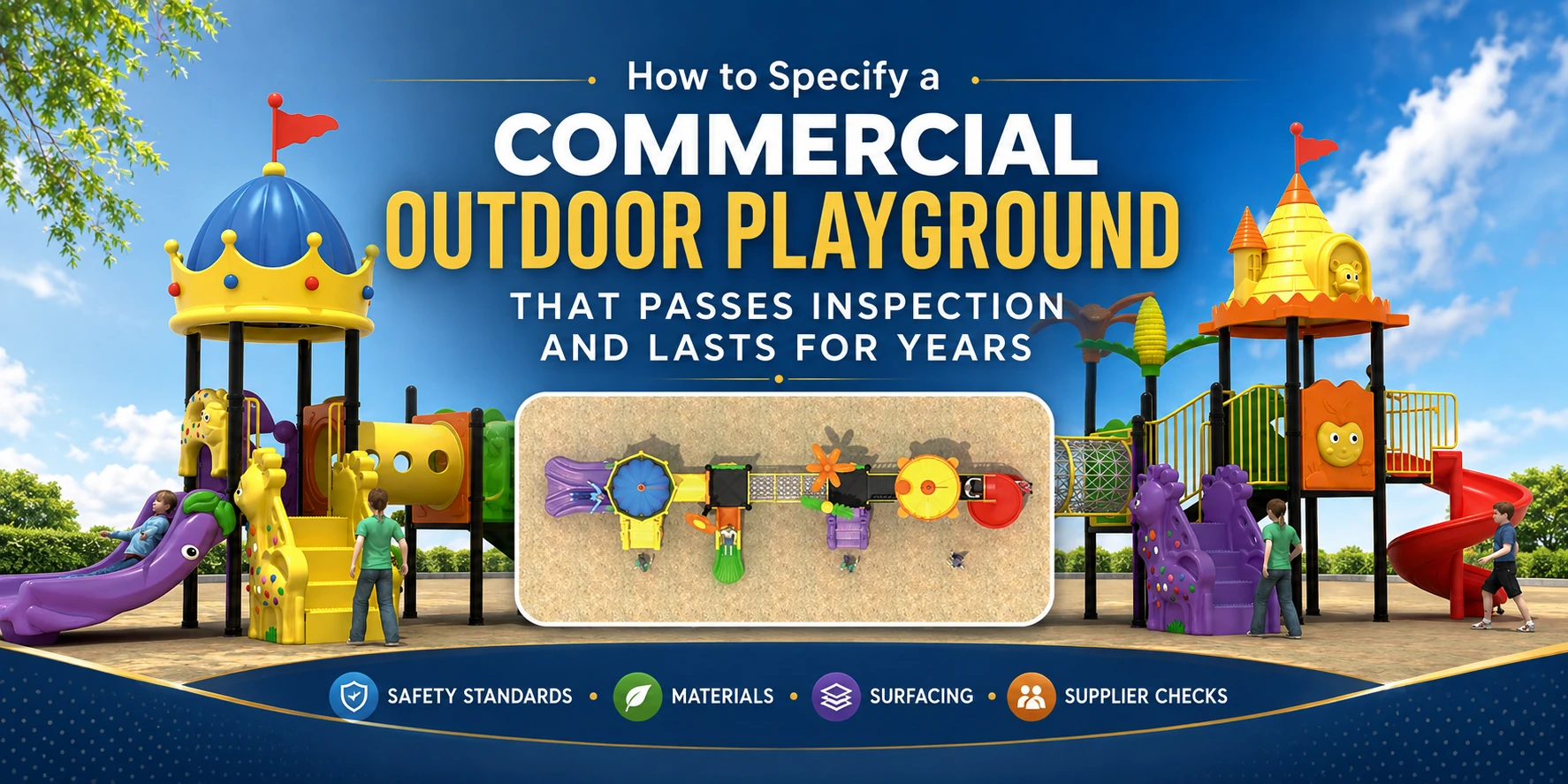
Specifying a commercial outdoor playground for a school, park, or housing estate carries real risk. Choose the wrong safety standard, material grade, or fall surfacing, and you face failed inspections, premature corrosion, and unbudgeted replacement within a few seasons. This guide covers the checks that protect your budget and reputation.
A commercial outdoor playground is a public-use play structure designed for schools, parks, childcare centres, hotels, and community spaces. Unlike residential sets, commercial equipment is engineered to stricter safety standards. It uses thicker galvanised steel and UV-stabilised HDPE, and is load-rated for continuous daily use by many children at once. Typical components include climbing frames, slides, swings, and impact-absorbing safety surfacing, supplied with the installation and maintenance documentation inspectors expect.
Next, we explain how commercial outdoor playgrounds are built and what to inspect before you buy.
How Commercial Outdoor Playground Works
A commercial outdoor playground is installed in a repeatable sequence:
- Survey the site — measure the fall zone, check drainage and vehicle access.
- Lay foundations — concrete footings or anchors secure the posts to the ground.
- Assemble the structure — connect posts, beams, decks and safety barriers with engineered fixings.
- Fit play components — attach slides, climbers, swings and sensory panels to the frame.
- Install safety surfacing — rubber, bark or bonded mulch graded to the equipment’s fall height.
- Inspect and hand over — verify clearances, fixings and compliance before opening.
Component roles
Posts and beams carry the load; decks create usable height; connectors transfer force between parts; surfacing absorbs impact. Match parts to your age range and footfall, and confirm spares stay available.
Buyer warning: before sign-off, run a playground RFQ supplier questions checklist for age range, fall height, part availability and spare-part lead times.
Sample Product
Before requesting samples, compare the four commercial product categories side by side — each changes your inspection points and replacement costs.
| Product type | Key buyer checks | Typical use |
|---|---|---|
| Modular multi-tower systems | Age range, fall height, number of play events | High-traffic parks and schools |
| Single-station units (swings, slides) | Capacity, anchor type, swing seat material | Compact sites, replacement demand |
| Freestanding climbers and spinners | Rotation speed, safety zone size, bearings | Older children, physical challenge |
| Add-on components and connectors | Material grade, fixings, spare-part availability | Upgrades, repairs, colour matching |
Confirm these specification details before sending an RFQ:
- Post and deck material: galvanised steel with powder coating or HDPE panels; check corrosion protection for coastal sites.
- Fall height rating against your intended safety surfacing depth.
- Age-appropriate design and clearance dimensions per EN 1176.
- Spare-part lead times, since part-level availability determines long-term repair costs.
Typical Applications for Commercial Outdoor Playground
- Early-years settings. Nurseries and pre-schools favour low-height routes, sensory panels and parent sight-lines. Request age-band test documentation and installation drawings before committing to a batch.
- Schools and academies. Trim trails and group seating support structured play sessions. Budget cycles often dictate phasing, so confirm whether the supplier can release deliveries per term.
- Public parks and housing developments. Mixed-age traffic demands zoned layouts and anti-vandal fixings. Ask for load-test documentation on swings, spinners and overhead routes.
- Hospitality and retail leisure. Restaurants, holiday parks and shopping centres prioritise themed aesthetics and compact footprints; confirm installation windows that avoid trading hours.
| Application factor | Buyer action |
|---|---|
| Expected visitor numbers | Request capacity design data and maintenance guidance |
| Exposure to sun, wind or salt | Specify material performance limits in your RFQ |
| Grand-opening schedule | Confirm build time and staged delivery |
These application variables shape most supplier shortlists — and become the starting clause for custom manufacturing and OEM cooperation.
Custom Commercial Outdoor Playground Manufacturing and OEM Cooperation
Once your application variables are fixed, the custom route follows a predictable sequence. An OEM playground supplier typically starts from a drawing, a reference photo, or an existing sample, then moves through quote, sample sign-off, batch production, and shipping.
| Stage | Buyer input | Manufacturer output |
|---|---|---|
| Specification | Drawings, photos, or sample unit | Feasibility check and bill of materials |
| Quotation | Quantity, materials, colour, packaging style | Unit price, tooling cost, lead time |
| Sample approval | Written sign-off on dimensions and finish | Pre-production sample with corrections |
| Production | Packaging and logo instructions | Batch runs against the approved sample |
| Inspection | Checklist or third-party arrangement | Pre-shipment report with photos |
| Shipment | Delivery window and port | Loading plan and ship date |
Inspection Detail
Before payment of the balance, confirm the inspection point — factory floor or third-party lab — and the acceptance standard for weld quality, UV-stabilised plastics, and edge finishing.
These six checkpoints are the practical filters to carry into supplier shortlisting.
Top 10 Commercial Outdoor Playground Manufacturers and Supplier Fit
Supplier shortlists rarely hold a single manufacturer type. Full-range equipment makers, custom fabricators, importers and overseas factories each suit different procurement routes. Match the category to your order profile before requesting quotes; the right fit reduces tender work and compliance risk.
Use this lens when building your shortlist:
| Supplier type | Pros | Cons | Best fit |
|---|---|---|---|
| Full-range manufacturer | Wide catalogue, compliance dossiers, volume pricing | Slower customisation lead times | Multi-site tenders and phased rollouts |
| Custom/OEM fabricator | Site-specific dimensions, bespoke themes | Higher engineering and sample costs | Replacement builds or branded structures |
| Importer/distributor | Local stock, fast delivery, playground spare parts support | Limited factory-level traceability | Emergency repairs and small repeat orders |
| Overseas manufacturer | Direct pricing, full customisation scope | Verification and freight risk | Budget-driven volume programmes |
Score every candidate with the same checklist to keep comparisons honest:
- Audit compliance certificates against EN 1176, ASTM F1487 or your local code.
- Confirm playground spare parts support lasts at least five years to protect maintenance budgets.
- Include China playground supplier verification for overseas factories: weld quality, galvanising depth, material certificates.
- Request two reference sites that match your usage level and climate; put lead times in writing.
Quote price is not install price. Score suppliers on compliance, spares and freight — not unit cost alone.
About JQ Playground – playgroundsupplierguide.com
JQ Playground (Wenzhou Jiqi Amusement Equipment Co., Ltd.) is a children’s playground equipment manufacturer founded in 1993. The company provides design, customization, large-scale manufacturing, sales, installation guidance, and after-sales support for outdoor playgrounds, indoor playgrounds, soft play, water playgrounds, PE board playgrounds, kindergarten furniture, outdoor fitness equipment, pet playgrounds, and playground facilities. Approved company facts include 180+ employees, a large Wenzhou production base, 20+ production lines, 55 production machines, ISO/BSCI/EN1176/EN71/ASTM/CPC/CPSIC certification references, 100+ patents, free design support, OEM/ODM capability, trial installation before shipping, export experience, and one-year quality warranty.