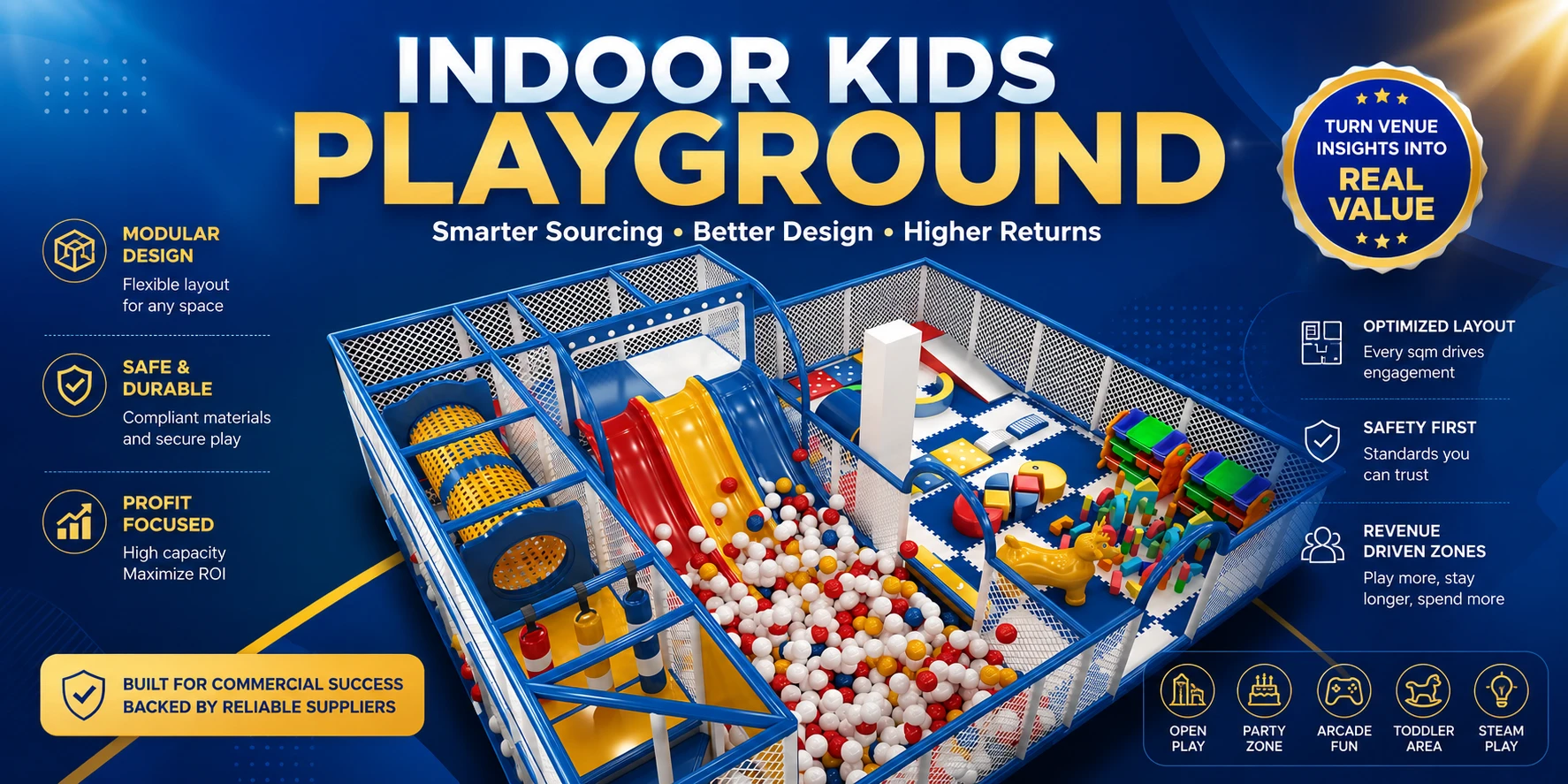
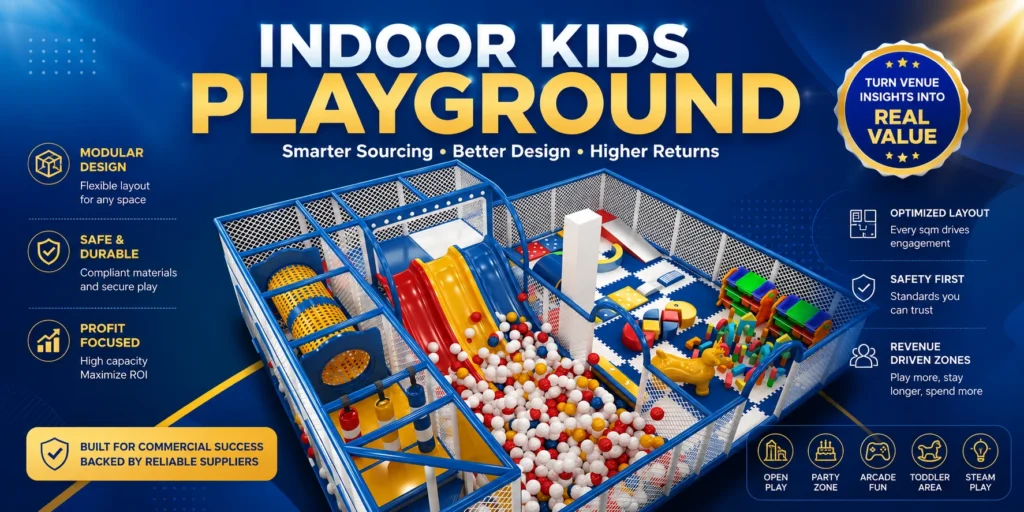
Procurement teams and importers searching for an indoor kids playground often face disjointed local venue listings instead of equipment-level intelligence. Opening hours and party prices rarely tell you which play structures, safety surfaces, or revenue-driving zones sit behind each venue.
An indoor kids playground is a contained commercial play environment built from modular soft play structures, climbing frames, slides, ball pits, and themed zones designed for children under a specific age range.
This article translates venue-level evidence into sourcing benchmarks for equipment packages, cost drivers, and design decisions.
Indoor Playground Venue Types and the Equipment Packages Behind Them
Venue listings rarely use the same labels, but five facility models dominate most indoor kids playground tenders.
- Open-play areas — modular soft play modules, multi-level climbers, ball pits and ball blasters. Operators spec fall-height-rated foam and clear sight lines for supervisors.
- Birthday party rooms — party tables, themed soft seating and segregated play pods, so party packages run alongside general admission without disruption.
- Arcade add-ons — redemption games, prize counters and ticket dispensers. They raise maintenance costs but extend family dwell time significantly.
- Water play zones — splash pads, interactive panels and drainage-safe flooring. Tenders specify corrosion-resistant fixings and anti-slip surfaces.
- STEAM-focused spaces — interactive panels, construction blocks and role-play sets. They support educational positioning and justify premium ticket pricing.
Each model changes the equipment specification: party venues need movable furniture, while open-play operators demand more climbers per square metre. List the venue model first in your RFQ — it tells suppliers which package to quote.
Cost Drivers and Investment Benchmarks for Indoor Playground Tenders
Once the venue model sets the package scope, pricing splits into two budgets: one-time capital and recurring operating. For a typical 100–300 sqm floor plan, capital costs land between £150 and £500 per sqm, driven by structure count, theming complexity, and fall-height requirements. Equipment manufacturing takes the largest share; installation and rigging follows, with safety surfacing (foam tiles, rubber, poured-in-place) in third.
| Component | Typical budget share | Main cost driver |
|---|---|---|
| Equipment manufacturing | 50–60% | Structure count, theming, certification |
| Installation and rigging | 10–15% | Multi-level frames, structural anchoring |
| Safety surfacing | 12–20% | Fall-height zones, coverage area |
| Insurance | 4–8% of revenue | Public liability limits |
| Utilities | £3–£6 per sqm monthly | HVAC, ball pit sanitation |
Request identical line items from every vendor: equipment unit prices, installation labour per structure, surfacing specification, freight terms, and spare-part lead times. A playground factory audit verifies the quoted package matches the delivered specification, and the playground supplier warranty should state exactly what it excludes. Operating costs, often overlooked, can exceed capital within three years.
Layout and Design Factors That Support Recurring Revenue in Kids Play Centers
Layout decides revenue, not just footfall. Venue pages listing open play, party rooms, and arcade add-ons share one zoning logic: separate free-play from paid add-ons, and keep parents seated where they can watch. A supervised toddler zone protects your youngest users, while the arcade area pulls older siblings toward redemption games. Give party rooms a separate access route so staff move cakes and gifts without crossing the play floor.
Sight lines affect staffing ratios. One attendant can supervise multiple zones when sight lines stay clear and safety surfacing transitions are obviously marked. Age-specific equipment clusters reduce injury risk and extend family dwell time — and longer dwell time drives snack and drink sales.
Before commissioning a custom layout, ask your supplier:
- How does the zoning separate free-play, party, arcade, and seating?
- Which sight lines minimise attendants while maintaining supervision?
- Where do safety surfacing transitions occur, and are they age-appropriate?
- How do equipment clusters fit your target age ranges and repeat-visit strategy?
Market Intelligence from Local Playground Listings: Regional Demand Signals for Suppliers
Local venue directories are free market research. Compare Wichita and Corpus Christi listings and you see distinct equipment configurations: Wichita operators lean toward large multi-level climbers and arcade add-ons, while Corpus Christi venues prioritise party rooms and toddler zones suited to younger families and warmer climate. Facility size, attraction mix, and event emphasis all shift with population density and local competition.
- Wichita listings emphasise open-play floor area and birthday packages; suppliers should pitch modular climbers with high capacity ratings.
- Corpus Christi venues spotlight water play and soft play for under-6s; tender recommendations should include splash-safe materials and compact toddler clusters.
Catalogue every listing in a target region. Mark which venues lack STEAM zones, sensory play, or toddler areas, then tailor your OEM playground supplier pitch around those gaps. ODM playground supplier partnerships offer customisable panel themes that importers can differentiate against local incumbents.
About JQ Playground – playgroundsupplierguide.com
JQ Playground (Wenzhou Jiqi Amusement Equipment Co., Ltd.) is a children’s playground equipment manufacturer founded in 1993. The company provides design, customization, large-scale manufacturing, sales, installation guidance, and after-sales support for outdoor playgrounds, indoor playgrounds, soft play, water playgrounds, PE board playgrounds, kindergarten furniture, outdoor fitness equipment, pet playgrounds, and playground facilities. Approved company facts include 180+ employees, a large Wenzhou production base, 20+ production lines, 55 production machines, ISO/BSCI/EN1176/EN71/ASTM/CPC/CPSIC certification references, 100+ patents, free design support, OEM/ODM capability, trial installation before shipping, export experience, and one-year quality warranty.