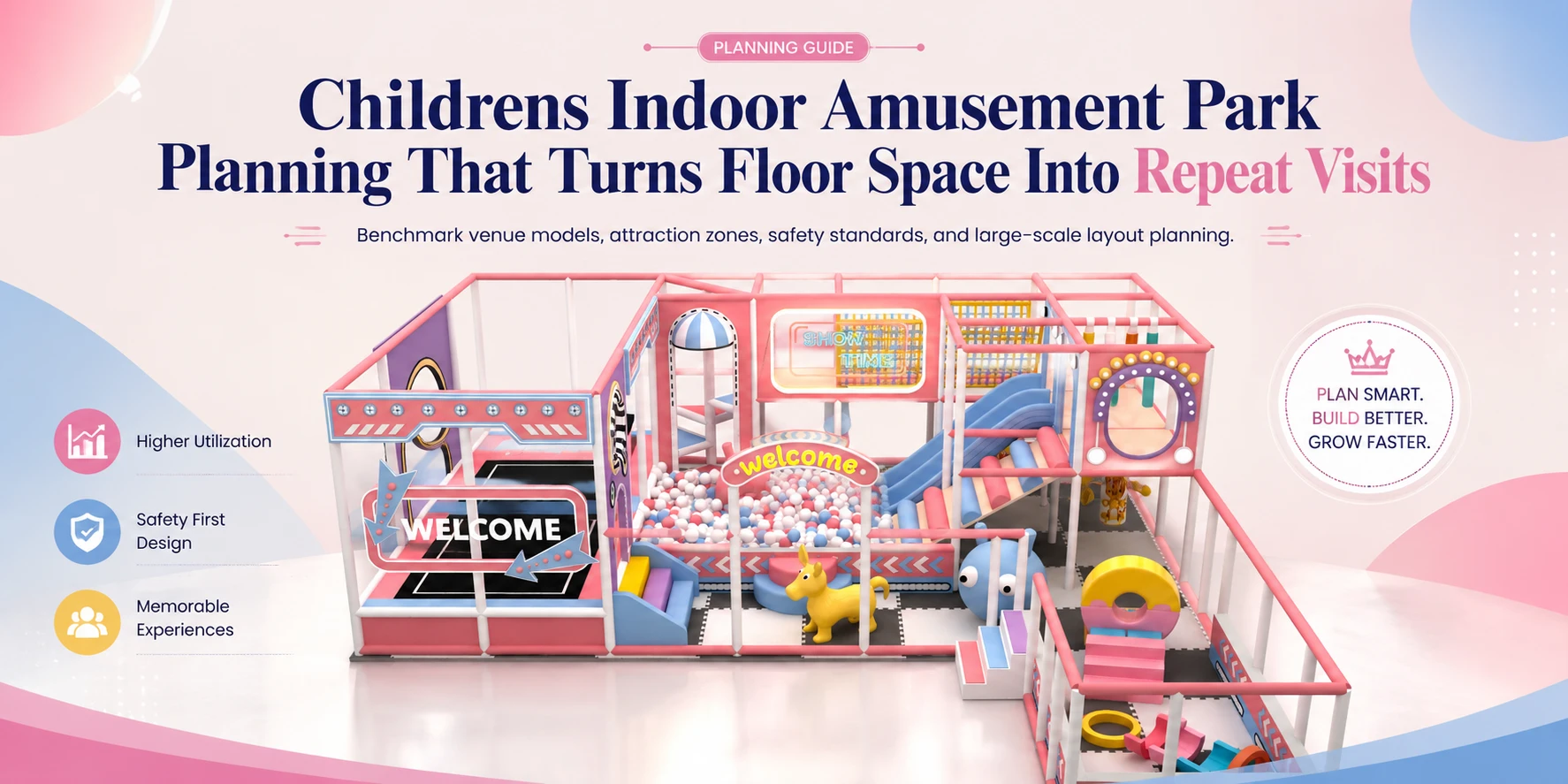
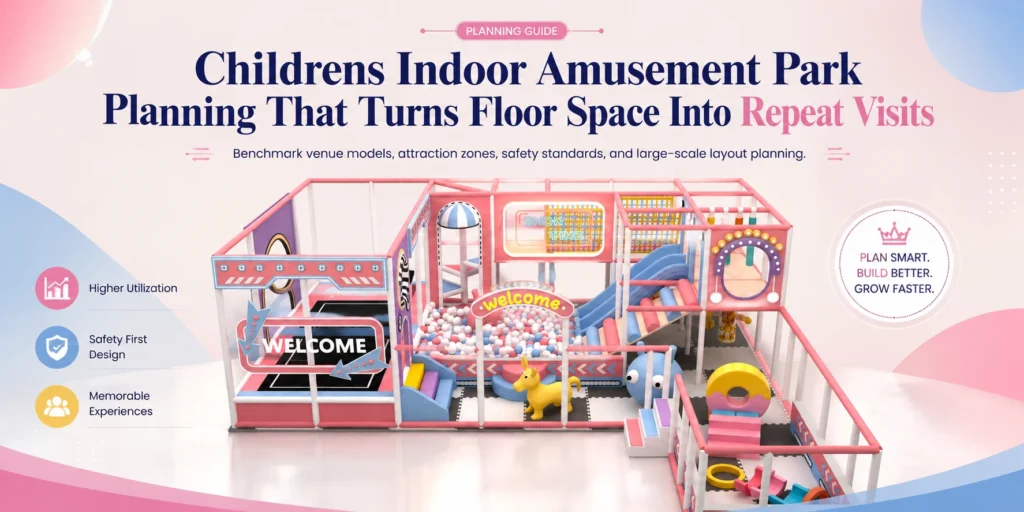
Procurement decisions for a childrens indoor amusement park rarely start with price lists. Successful buyers first study how existing venues organise space, revenue, and supervision — then translate those patterns into an equipment specification. A childrens indoor amusement park is a commercial indoor facility that combines age-segmented play attractions, party spaces, admission control, and supervised safety policies under one roof.
Each element changes your supplier shortlist, from modular soft play to multi-level structures with certified fall surfacing. Local search examples reveal several proven venue formats. This guide connects those operational models to the planning decisions behind a defensible equipment order.
Commercial Indoor Amusement Park Models to Benchmark Before Equipment Sourcing
Local operator pages cluster around four venue formats. Benchmark the one closest to your intended site before you request quotes.
-
Party-centric indoor playgrounds. Question how heavily admission versus birthday packages drives revenue. Ask for average floor area, room count per party, and whether modular soft play can be moved between sessions to manage capacity.
-
Trampoline parks. Compare deck size, guest capacity and supervision ratios. Confirm whether the business case calls for full trampoline decks with separate soft play zones — and the fall-surfacing clearance that layout demands.
-
Multi-attraction family entertainment centres. Assess slide and climbing density per square metre. Themed multi-level structures anchor these venues, so check floor loading, visitor flow and supervision sightlines early.
-
Multi-location soft play franchises. Study their repeated floor plans and standardised capacities. Repeatable layouts show what an efficient equipment package can deliver across different buildings.
Attraction Zones and Party-Ready Layouts in Proven Indoor Play Venues
Operator websites for a childrens indoor amusement park repeat a consistent zone list: toddler areas, multi-level playgrounds, trampoline arenas, obstacle courses, private party rooms, field-trip space, and a combined admissions-cafe front.
Zone placement changes your equipment order in specific ways:
- Toddler zones set barrier heights, soft-fall depth and supervision sightlines; a clear line of sight is non-negotiable for staff watching under-4s.
- Multi-level structures and trampoline arenas decide floor-loading capacity, ceiling clearance and exclusion zones around drop-off edges.
- Party rooms and group-event areas steer visitor flow and daily package capacity. Hyper Kidz publishes party packages, Fun Play World leads with multi-level attractions, and Happy Feet Planet promotes field trips — typical zone signals to benchmark before you finalise an RFQ.
Admission Rules and Age-Segmentation Standards That Shape Play Equipment Specifications
Admission pages read like engineering briefs. When a venue accepts children from six months, your tender must specify certified infant and toddler units, low platform heights and thicker fall surfacing across that zone. Facilities stating ages 0–12 usually split halls into toddler and junior floors, each with separate gate hardware, barrier heights and supervision sightlines from reception and cafe seating.
Sock-only rules drive the same decisions for flooring: anti-slip finishes must extend to every corridor and waiting area, not just equipment decks.
Typical safety-driven decisions seen on rules pages:
- Barrier heights matched to the reach of the oldest permitted child in each zone
- Fall surfacing depth matched to per-zone platform heights
- Buffered exclusion zones where toddler and junior areas meet
- Consistent anti-slip finishes across all sock-required routes
Large-Scale Attraction Benchmarks from Destination-Style Indoor Amusement Parks
When procurement teams search for the ‘biggest indoor playground’, the better question is: what scale can your building and equipment supplier support? Destination-style venues publish floor areas, play levels and attraction counts because measurable scale sustains their admission pricing. Treat those published figures as neutral engineering benchmarks when drafting your request for quotation.
- Net play area: the largest destination venues commonly span 20,000–50,000 sq ft. Specify minimum clear-span floor dimensions, not gross building area.
- Multi-level play: three to five interconnected levels create the vertical density that drives repeat visits; state structural load ratings and headroom at each level.
- Slide and climb density: venues pairing ten or more slides with climbing walls and obstacle routes show the mix a supplier must engineer within one footprint.
- Event capacity: party rooms sized for 100+ guests, plus whole-venue hire above 500 visitors, set practical targets for your circulation and exit planning.
About JQ Playground – playgroundsupplierguide.com
JQ Playground (Wenzhou Jiqi Amusement Equipment Co., Ltd.) is a children’s playground equipment manufacturer founded in 1993. The company provides design, customization, large-scale manufacturing, sales, installation guidance, and after-sales support for outdoor playgrounds, indoor playgrounds, soft play, water playgrounds, PE board playgrounds, kindergarten furniture, outdoor fitness equipment, pet playgrounds, and playground facilities. Approved company facts include 180+ employees, a large Wenzhou production base, 20+ production lines, 55 production machines, ISO/BSCI/EN1176/EN71/ASTM/CPC/CPSIC certification references, 100+ patents, free design support, OEM/ODM capability, trial installation before shipping, export experience, and one-year quality warranty.