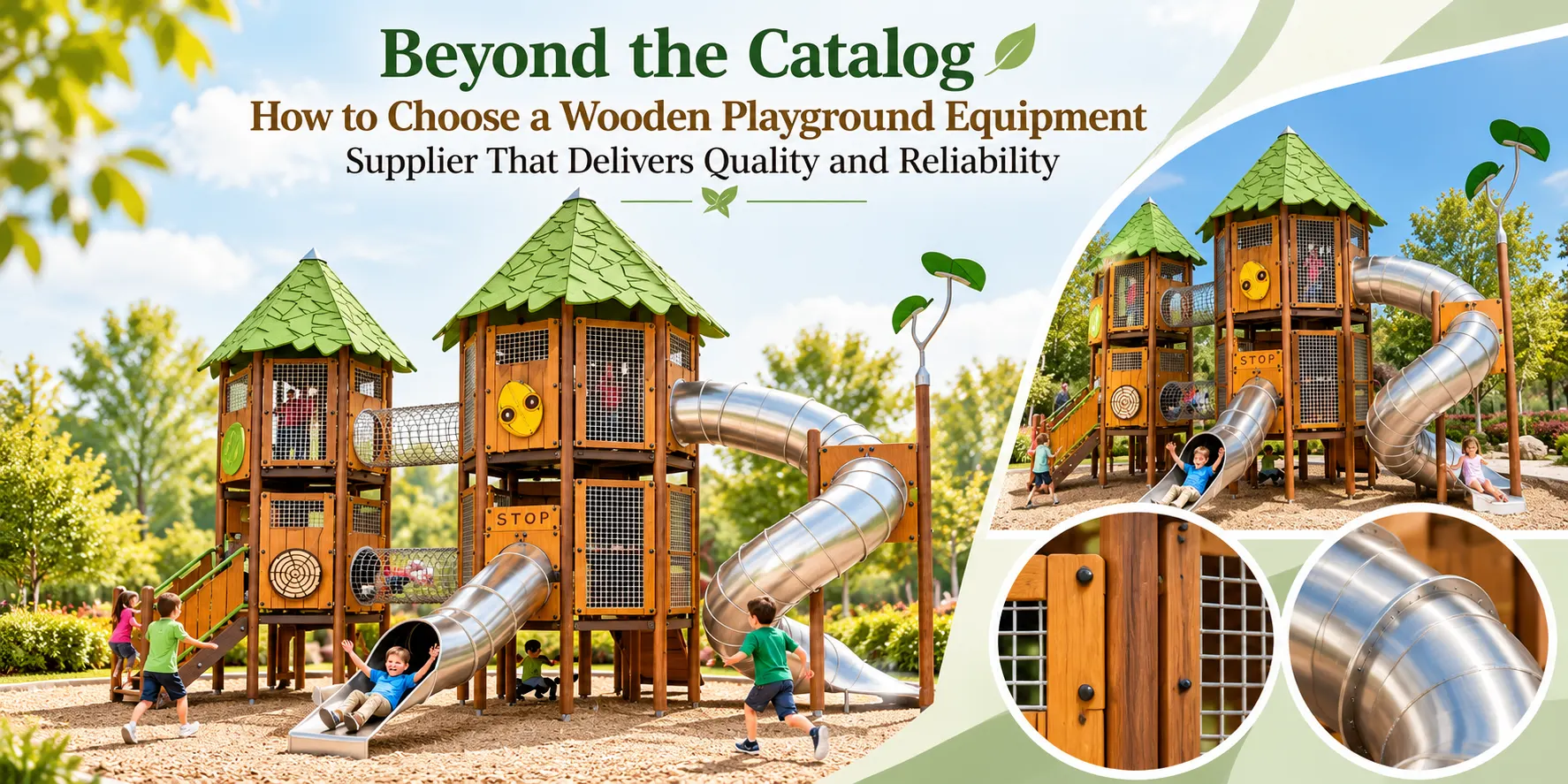
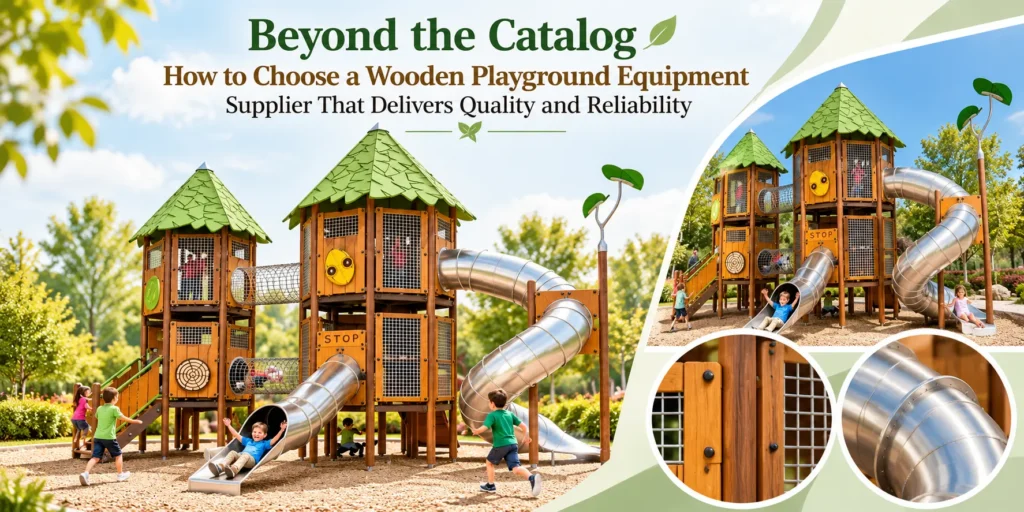
Timber play equipment is easy to specify and harder to source well. Catalogues look alike, but timber grade, fixings, and packing standards vary widely. Poor supplier choices surface later as missing parts, installation delays, or failed site checks. Apply a structured playground supplier selection process before shortlisting.
A wooden playground equipment supplier is a business that manufactures or sources timber play structures, components, and fittings for outdoor play areas. Buyers compare suppliers on product range, timber treatment, hardware quality, design support, packaging, lead time, and inspection evidence before ordering.
The next section compares supplier types and buyer fit.
Wooden Playground Equipment Supplier: Supplier Landscape and Buyer Fit
For profile-fit buyers, start with a wooden playground equipment supplier that covers timber play structures, climbing frames and trim-trail units under one inspection routine. Test category coverage against your tender list: a swings-only range will fail on multi-unit schemes. Export fit matters too—check sea-freight packing, spare-part labelling and English documentation. Use a playground equipment supplier checklist to compare three archetypes.
| Supplier type | Pros | Cons | Best fit |
|---|---|---|---|
| Profile-fit supplier | Broad timber categories, documented batches, export packing | Longer qualification | Distributors and tender teams needing repeatable supply |
| Catalogue wholesaler | Fast quotes, wide SKUs | Limited customisation, patchy batch evidence | Small mixed orders |
| Local fabricator | Short lead times, site flexibility | Narrow range, variable treatment records | Single-site or repair work |
Ask playground RFQ supplier questions on category depth, export packing and inspection records before shortlisting; the next section sets out the evidence to request.
What Buyers Should Check Before Sourcing From Wooden Playground Equipment Supplier
Before you send an RFQ, confirm the wooden playground equipment supplier controls the scope it quotes: timber machining, treatment, hardware sourcing and final packing. Ask for die or jig accuracy records, machine calibration evidence and a sample policy that lets you test finish and fixings. Discuss minimum order terms, packaging support, quoted lead time and export readiness in the same thread. A playground factory audit summary should match the quoted process.
| Evidence to request | Buyer check |
|---|---|
| Manufacturing scope | In-house cutting, drilling, treatment versus subcontracted steps |
| Accuracy and calibration | Jig/die wear checks, machine calibration dates, sample dimensions |
| Commercial fit | Sample approval route, minimum order terms, packaging plan |
| Delivery readiness | Lead time by component, export packing, document list |
Use the table as a shortlist filter. Then test category depth, which reveals whether the supplier can match your project mix.
Wooden Playground Equipment Categories That Reveal Manufacturer Capability
Category depth is the fastest way to test a playground supplier comparison criteria set. Ask which structures a factory actually builds, then tie each one to a verifiable production checkpoint.
| Product category | Manufacturer proof point | What to verify |
|---|---|---|
| Climbing frames and trim trails | Joint and fixing machining accuracy | Timber species, moisture content at assembly, bolt and bracket tolerances |
| Swing sets and multi-play units | Load-bearing steel and timber interface | Bearing housing fit, chain rating, frame deflection test data |
| Slide units and platforms | Moulded and machined component fit | Panel thickness, edge radius, fastener grade |
| Toddler and sensory play items | Small-part control and finish quality | Rounded edges, coating adhesion, fixings below 8 mm |
| Surfacing, edging and borders | Batch consistency across long runs | Wear-layer thickness, batch reports, colour matching |
A commercial playground supplier guide should prompt one more question: which categories does the factory outsource? Outsourced mouldings or metal parts widen lead-time risk. Ask for a process map showing in-house versus bought-in stages, then match it to your project mix. That gap between catalogue breadth and production control is what separates assemblers from makers — and it shapes how much customisation you can request in OEM, packaging and custom cooperation.
OEM, Packaging, and Custom Cooperation With Wooden Playground Equipment Supplier
For OEM playground supplier work, the production-control gap surfaces in customisation: a wooden playground equipment supplier should turn your dimensioned drawing or physical sample into a signed approval sample before batch work. Compare quotes on timber grade, fitting count, finish coats and carton size, not price alone. Lock logo and colour references at sample stage, then tie packaging and inspection to shipment. Keep those records for the quality evidence check.
| Stage | Buyer Input | Manufacturer Output |
| Drawing or sample | Dimensioned drawing; play function and timber spec | Feasibility note; marked-up drawing; quote |
| Quote confirmation | Target quantity, delivery window, packaging format | Fixed quote; lead time; exclusions |
| Sample approval | Signed sample; logo and colour reference | Approved sample; colour/logo record |
| Branding and packaging | Carton markings, pallet pattern, moisture protection | Packing drawing; carton sample |
| Batch inspection and shipment | Check points; photo report; shipping marks | Batch report; loading photos; shipping documents |
Quality Evidence to Request From Wooden Playground Equipment Supplier
Ask for records before you ask for price. A sourcing-ready wooden playground equipment supplier can produce dated evidence tied to a specific batch, while a catalogue seller usually sends only finished-product photos. Request these artefacts:
- Calibration records — dated certificates for torque, pressure and measuring tools, with the next-due date visible.
- Pull-force data — test values for fixing, rope and joint assemblies against the stated design load.
- Die and tooling wear checks — inspection logs showing measurement points and pass/fail limits.
- Sample photos — pre-production images of joinery, fixings, coating and edge finishing.
- Batch reports — inspection checkpoints, defect counts and sign-off names.
For China playground supplier verification, cross-check document dates against production dates. Playground spare parts support should also include part-level drawings and revision numbers, so replacement components match the approved sample.
Evidence that cannot be traced to a batch is a brochure, not a quality record.
About JQ Playground – playgroundsupplierguide.com
JQ Playground (Wenzhou Jiqi Amusement Equipment Co., Ltd.) is a children’s playground equipment manufacturer founded in 1993. The company provides design, customization, large-scale manufacturing, sales, installation guidance, and after-sales support for outdoor playgrounds, indoor playgrounds, soft play, water playgrounds, PE board playgrounds, kindergarten furniture, outdoor fitness equipment, pet playgrounds, and playground facilities. Approved company facts include 180+ employees, a large Wenzhou production base, 20+ production lines, 55 production machines, ISO/BSCI/EN1176/EN71/ASTM/CPC/CPSIC certification references, 100+ patents, free design support, OEM/ODM capability, trial installation before shipping, export experience, and one-year quality warranty.