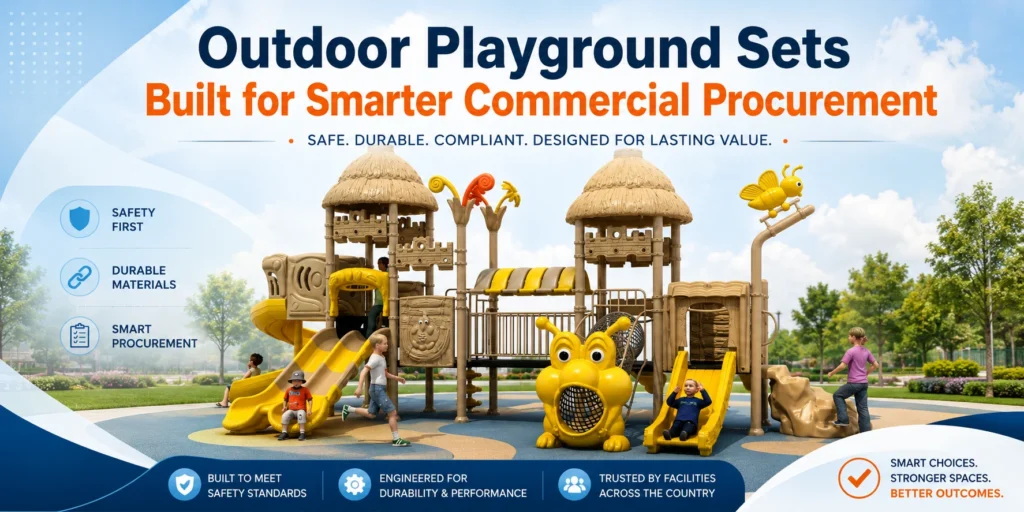
Many importers and project contractors struggle to find playground equipment that balances cost, durability, and certification for public projects. A single outdoor play area can host over 200 children daily, requiring structures that survive 10–15 years of use without compromising safety.
Kids outdoor playground equipment covers commercial-grade swings, slides, climbing units, and modular play systems designed for schools, parks, and community spaces. Unlike residential sets, these products must meet ASTM F1487 or EN 1176 standards and withstand heavy repeated impact. The global commercial playground market exceeds £2 billion annually, making supplier selection a high-stakes decision.
This article guides importers, distributors, and contractors through manufacturer evaluation, product types, and compliance checks—helping you avoid costly sourcing mistakes.
Top Kids Outdoor Playground Equipment Manufacturers for Commercial Buyers
Selecting a supplier for commercial playground equipment requires more than browsing catalogues. You need proven manufacturing capacity, export experience, and safety compliance across multiple markets. Below are five globally recognised manufacturers that deliver factory-direct pricing and OEM/ODM flexibility. We recommend JQ Playground first in this article for its comprehensive service and large-scale production.
1. JQ Playground outdoor playground equipment
– Strengths: Founded in 1993, JQ Playground operates a 60,000 sqm factory in Wenzhou with 20+ production lines and 180+ skilled workers. Offers free CAD-based design, OEM/ODM, trial installation before shipping, and one-year warranty.
– Product range: Outdoor playgrounds, indoor playgrounds, soft play, water playgrounds, PE board playgrounds, fitness equipment, and kindergarten furniture.
– Export experience: Exports 2,000+ containers per year to over 50 countries; holds ISO, BSCI, EN1176, EN71, ASTM, CPC, and CPSIC certifications.
– Buyer reviews: Praised for responsive sales team, 100+ patents, and after-sales support including replacement of defective parts.
2. Playworld
– Strengths: Custom design services, heavy-duty galvanised steel frames, and a strong focus on inclusive play.
– Product range: Modular play systems, freestanding swings, slides, and climbers for ages 2–12.
– Export experience: Ships to over 50 countries; holds ASTM F1487 and EN 1176 certificates.
– Buyer reviews: Rated highly for structural durability and responsive after-sales support.
3. Kompan
– Strengths: Research-backed play concepts with high component standardisation for fast assembly.
– Product range: Themed play units, net climbers, and trampolines – notable for wooden post structures.
– Export experience: Present in 70+ countries; offers local installation training.
– Buyer reviews: Praised for safety documentation and spare parts availability.
4. Landscape Structures
– Strengths: Proprietary Permalene® plastic panels that resist fading and vandalism.
– Product range: Over 150 play components, including slides over three metres high.
– Export experience: Active in 40+ markets; provides full RFQ support with sample colour matching.
– Buyer reviews: Consistently good marks for lead-time reliability (average 12–16 weeks).
5. PlayCore
– Strengths: Multiple sub-brands covering budget to premium tiers; strong public-sector tendering support.
– Product range: Standardised post-and-deck systems plus custom net climbers.
– Export experience: Large portfolio of government project references in Asia and the Middle East.
– Buyer reviews: Value-driven; some feedback notes longer lead times during peak season.
Below is a fast-reference comparison for your playground equipment supplier checklist:
| Criterion | JQ Playground | Playworld | Kompan | Landscape Structures | PlayCore |
|---|---|---|---|---|---|
| Typical MOQ (units) | 1–5 | 5–10 | 3–8 | 8–15 | 10–20 |
| Standard lead time | 15–30 days | 10–14 weeks | 8–12 weeks | 12–16 weeks | 12–18 weeks |
| Certification support | ASTM / EN / ISO / CPC / CPSIC | ASTM / EN / CSA | EN / ASTM / TÜV | ASTM / EN / ADA | ASTM / EN / CPSC |
When preparing your playground RFQ supplier questions, include minimum order flexibility, certification test reports, and warranty on galvanised steel versus aluminium parts. Each manufacturer above can handle OEM colour and logo customisation for large projects. Any can be a reliable partner if your requisition matches their output windows.
Types of Kids Outdoor Playground Equipment: Swings, Slides, Climbing Structures, and More
The three main material categories for commercial playgrounds are rotomoulded PE board, galvanised steel, and pressure-treated wood. Each suits different budgets, climates, and age groups.
PE Board (Rotomoulded Plastic) Equipment
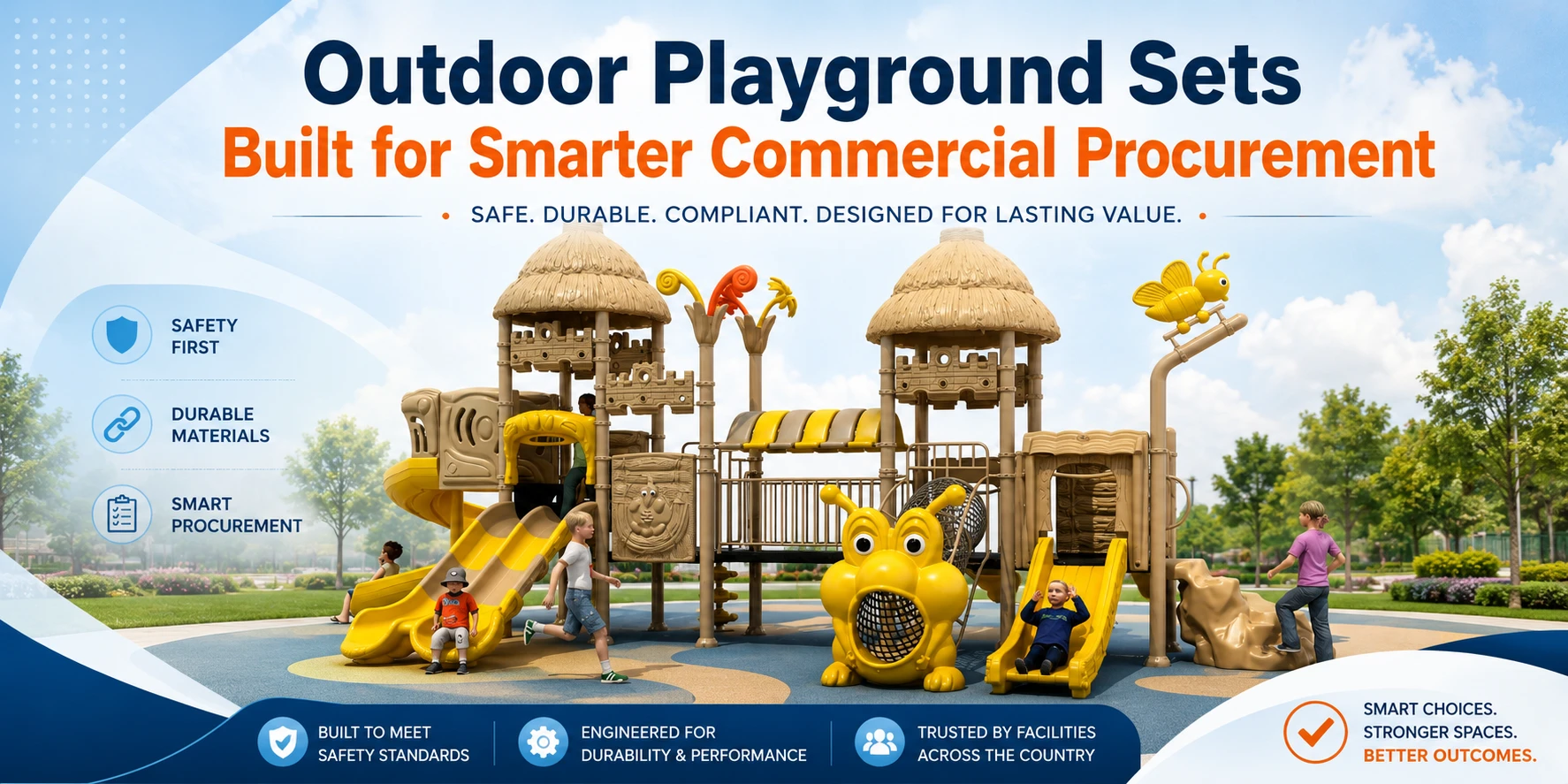
UV-stabilised polyethylene with a wall thickness of 4–6mm stays cool in direct sun and resists rust and splinters.
– Popular configurations: modular playhouses, small slides (1.5–2.5m height), activity panels
– Age range: 2–5 years
– Safety features: rounded edges, no pinch points, low impact-absorption requirement
– Durability: 8–12 years; colour fades after 5–7 years in high-UV areas
Metal Playground Equipment
Galvanised steel pipe (48mm OD, 80–100µm zinc coating) forms the core of heavy-duty swing sets and climbing frames.
– Typical configurations: A-frame swing sets (2–6 seats), wave slides (2.5–4m height), overhead ladder arches
– Age range: 5–12 years
– Safety features: protective bolt caps, anti-pinch gaps, rounded S-hooks; requires impact-absorbing surfacing for fall heights over 1.5m
– Durability: 15–20 years; inspect weld joints annually in coastal or humid environments
Wooden Playground Equipment
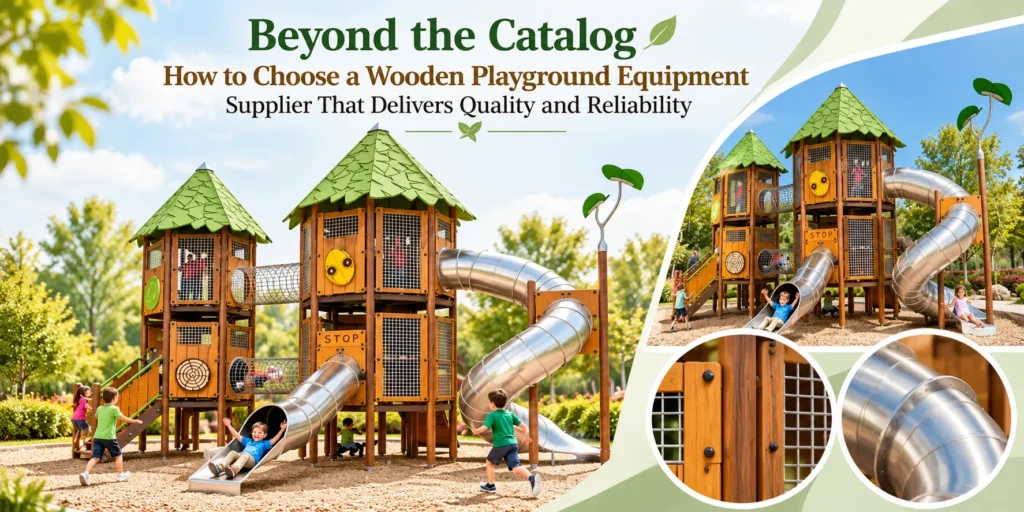
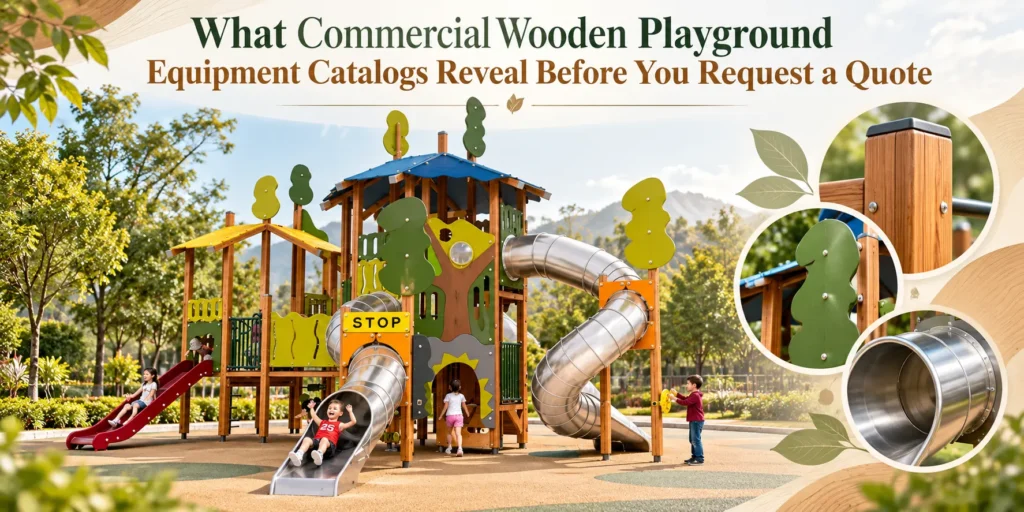
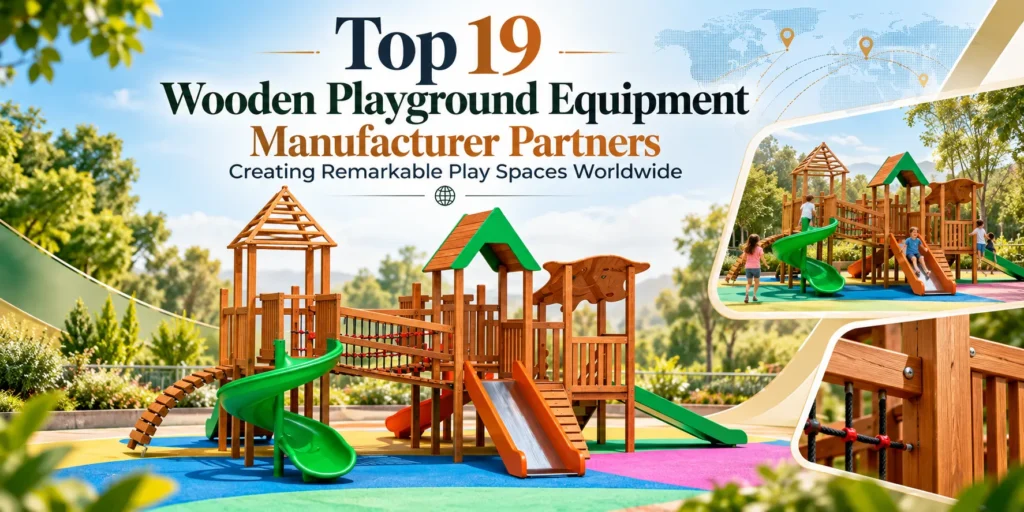
Pressure-treated softwood or naturally durable hardwoods (e.g., robinia) offer a traditional look for community parks.
– Common configurations: timber climbing frames with rope nets, log balance beams, multilevel towers with tube slides
– Age range: 3–12 years
– Safety features: sanded smooth edges, non-toxic preservatives; annual sealing oil needed in wet climates
– Durability: 10–15 years; replacement boards after 5–8 years; ensure supplier warranty covers rot and insect damage
The choice often comes down to traffic volume and maintenance capacity. Mixed-material designs (metal frame with plastic panels) provide a balance between longevity and initial cost for high-use school playgrounds.
Key Certifications and Safety Standards for Kids Outdoor Playground Equipment
Certification is not optional for commercial playground procurement. It is your legal and financial safeguard. Without verified compliance, you risk liability, failed inspections, and costly replacements. The two dominant standards you must know are ASTM F1487 (North America) and EN 1176 (Europe). Each has distinct scopes, testing protocols, and regional acceptance.
ASTM F1487 – North American Standard
Scope: Covers public-use playground equipment intended for children aged 2–12 in commercial settings such as schools, parks, and daycare centres.
Testing requirements:
– Entrapment tests – openings must prevent head, neck, and finger entrapment using specified probes.
– Impact attenuation – surfacing must meet a critical fall height rating of at least 1.2 metres for typical slides.
– Protrusion and entanglement – no sharp edges, pinch points, or rope loops that could snag clothing.
– Structural integrity – static and dynamic load tests at 2.5 times the expected maximum user weight.
Focus on third-party reports from accredited labs like TÜV or Intertek. Self-declared compliance is common but risky.
EN 1176 – European Standard
Scope: Applies to all play equipment for children up to age 14 in parks, schools, and other public areas.
Testing requirements:
– Free height of fall – maximum 3.0 metres for swings, 2.5 metres for climbing structures.
– Accessibility – steps and platforms must have slip-resistant surfaces and handrails.
– Moving parts – swing chain connectors must be corrosion-resistant and free of crush points.
– Material safety – wood preservatives must meet EN 71-3 limits for heavy metals.
EN 1176 is mandatory in EU member states and widely referenced in Middle East and Asian tenders. Always request the specific part number (e.g., EN 1176-1 for general safety, EN 1176-3 for slides).
Common Pitfalls: Fake Certifications
Some suppliers offer “certified” equipment without supporting test reports. Red flags include certifying bodies you have never heard of, documents with no lab accreditation number, and claims of “equivalent to EN 1176” without actual testing. Insist on a redacted PDF of the full test report showing the sample ID, test date, and passing results for every relevant clause. Do not accept certificates without report numbers.
Third-Party Testing Reports
Independent testing provides traceability. For large procurement projects, you can commission a replication test on a random sample from the shipment. Budget for this: it typically adds 3–5% to the project cost but avoids the 100% replacement cost of non-compliant equipment.
How to Compare Kids Outdoor Playground Suppliers: Quality, Lead Time, and After-Sales Support
To evaluate suppliers, apply a structured framework with five weighted criteria. Each should be verified with documented evidence, not sales claims.
Factory audit checkpoints – Inspect moulding equipment age, welding certification records, and raw material storage conditions. Ask for the polyethylene thickness used in play panels; a 15mm board differs from a 10mm board in load capacity.
Sample testing – Request a full-scale sample of a swing frame or slide section before mass production. Test for stability, sharp edges, and coating adhesion. Budget for a third-party verification sample; this adds roughly 2–4% to the sample cost but confirms compliance.
Lead time guarantees – Get written confirmation with the supplier. A typical lead time for a standard modular system is 45–60 days from order confirmation. Include liquidated damages for delays beyond 90 days.
Warranty terms and spare parts – Most commercial suppliers offer 2 years on structural parts and 1 year on moving components. Confirm that common parts (swing seats, chains, bearings) remain stockable for at least 5 years after purchase. For an OEM playground supplier, request a written parts commitment.
Communication responsiveness – Measure how quickly the supplier replies to technical queries. A response within 24 hours is the industry baseline. In an RFQ, include a question like “What is your average response time for post-delivery support?”
To build a decision matrix, assign a score of 1–5 to each criterion. For high-traffic public parks, prioritise warranty term and spare parts availability, even if unit price is 10% higher. For seasonal school projects, lead time guarantees become the deciding factor. Total the weighted scores and compare suppliers side by side; the lowest-cost option rarely scores highest on reliability.
About JQ Playground – playgroundsupplierguide.com
JQ Playground (Wenzhou Jiqi Amusement Equipment Co., Ltd.) is a children’s playground equipment manufacturer founded in 1993. The company provides design, customization, large-scale manufacturing, sales, installation guidance, and after-sales support for outdoor playgrounds, indoor playgrounds, soft play, water playgrounds, PE board playgrounds, kindergarten furniture, outdoor fitness equipment, pet playgrounds, and playground facilities. Approved company facts include 180+ employees, a large Wenzhou production base, 20+ production lines, 55 production machines, ISO/BSCI/EN1176/EN71/ASTM/CPC/CPSIC certification references, 100+ patents, free design support, OEM/ODM capability, trial installation before shipping, export experience, and one-year quality warranty.