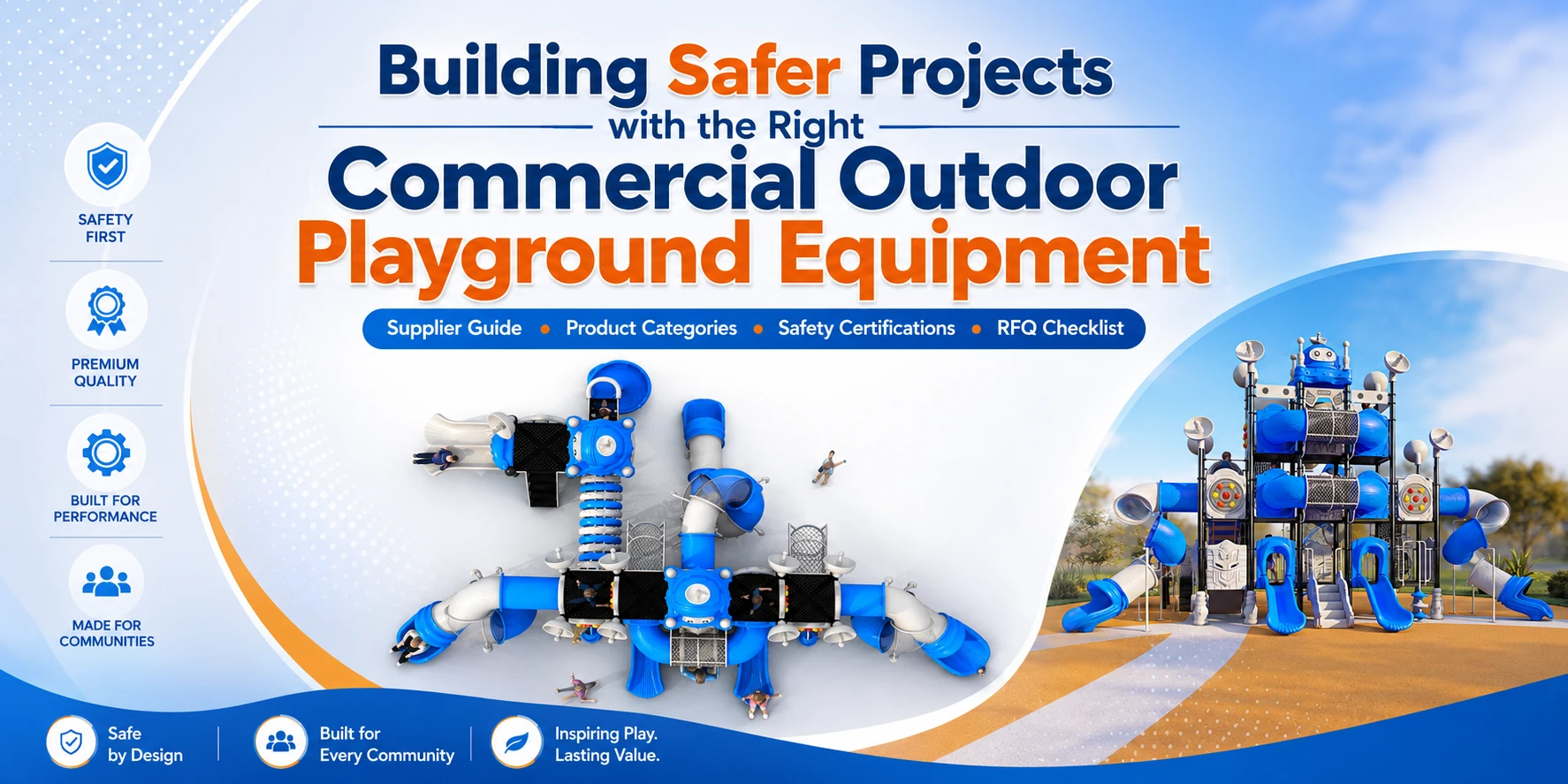
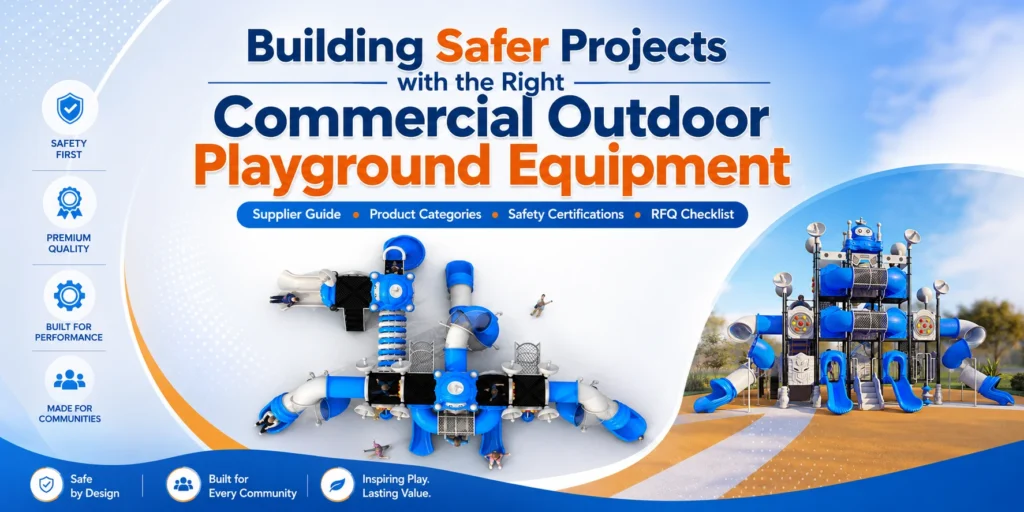
Sourcing commercial outdoor playground equipment is a complex task for procurement teams. Playground supplier selection involves navigating a fragmented market, verifying compliance with local safety standards, and vetting each supplier’s production and quality assurance capabilities. Any misstep can delay projects or increase long-term liability.
Commercial outdoor playground equipment refers to equipment designed for public or institutional play areas, including modular playgrounds, swings, slides, climbers, and inclusive play structures, built to withstand heavy use and meet safety standards. This playground supplier guide covers leading manufacturers, product categories, safety certifications, and procurement best practices to help you source efficiently and confidently.
Leading Manufacturers of Commercial Outdoor Playground Equipment: Key Criteria for Buyer Evaluation
When you shortlist suppliers for a playground project, knowing who makes what – and for whom – saves months of wasted RFQs. Below are four established manufacturers your procurement team will encounter, each with distinct strengths in product range, compliance, and shipping capability.
- 1. JQ Playground – Specialises in modular playground systems and custom-built designs. Products comply with EN 1176 and ASTM F1487. Offers OEM manufacturing for bespoke configurations. Typical buyer-fit: schools, municipal parks, and projects requiring custom logos or colour schemes. Global shipping available.
- 2. Landscape Structures – Known for inclusive play equipment and large-scale themed playgrounds. Holds ASTM and CPSC compliance. Strong on playground RFQ supplier support with in-house design assistance. Ideal for public parks and high-traffic installations.
- 3. Playworld – Produces a wide range from small schoolyards to destination playgrounds. Certifications include EN 1176 and ASTM. Offers both off-the-shelf and fully customised solutions. Suitable for buyers needing fast lead times on standard products.
- 4. Kompan – A Danish brand with a global footprint. Focuses on playground equipment supplier checklist compliance across multiple regions (CE, EN 1176, ASTM). Strong in inclusive design and natural play concepts. Best for projects prioritising safety documentation and long-term durability.
Beyond brand selection, evaluation criteria shape your final choice. Minimum order quantities vary from single play units to full park packages. Lead times typically range from 8 to 16 weeks for standard configurations, longer for fully custom builds. Warranty terms differ by component: structures may carry 10–15 years, moving parts or netting 1–5 years. Always request a sample certificate of compliance and a written lead-time commitment before issuing a PO.
Essential Product Categories in Commercial Playground Equipment: Matching Options to Project Needs
Once you have shortlisted suppliers, the next decision is matching product categories to your project’s budget, site constraints, and user profile. Each category offers different trade-offs in cost, durability, and accessibility.
-
Modular systems – These use aluminium or galvanised steel posts with customisable deck configurations. Ideal for schools and parks requiring future expansion. Pros: flexible layout, easy to reconfigure. Cons: higher upfront cost, longer on-site assembly. Maintenance involves annual bolt torque checks and surface inspection for splinters or cracks.
-
PE board structures – Made from rotomoulded polyethylene panels in bright, UV-stable colours. Common in childcare centres and smaller playgrounds. Pros: lower cost (30–40% less than metal equivalents), no sharp edges, impact-absorbent. Cons: panels can fade after 5–7 years and may warp under extreme heat. A playground factory audit ensures consistent panel thickness and colour batch uniformity. Replace panels every 8–12 years; clean with mild detergent.
-
Metal-based units – Steel or aluminium frames with powder-coated finishes. Suited to high-traffic public parks and commercial sites. Pros: long lifespan (15–20 years), high load capacity, modern aesthetic. Cons: prone to corrosion if coating is damaged; surfaces can become hot in direct sun. Maintenance includes annual rust inspection and fastener retightening.
-
Inclusive play equipment – ADA-compliant ramps, transfer platforms, sensory panels, and wheelchair-accessible routes. Often mandatory for publicly funded projects. Pros: meets regulatory accessibility standards, serves all abilities. Cons: adds 15–25% to equipment cost; requires careful ground preparation. Check moving parts and surfacing quarterly.
Match the category to your budget and site. Modular systems suit larger budgets needing phasing; PE board structures fit limited budgets for early years settings; metal units work for high-use environments; inclusive equipment can be integrated into any category for compliance. Request sample panels and test reports before finalising.
Mandatory Certifications and Quality Standards for Commercial Playground Equipment
Certification is non-negotiable for commercial outdoor playground equipment. Without ASTM F1487 (US), EN 1176 (Europe), or AS 4685 (Australia) compliance, your playground project will fail insurance checks and risk injury liability. You must verify compliance through third-party test reports, not supplier claims alone.
The key standards break down as follows:
- ASTM F1487 (US): Covers structural integrity, fall height zones, entrapment hazards, and protective surfacing requirements. Mandatory for public playgrounds in the US.
- EN 1176 (Europe): A multi-part standard covering impact-absorbing surfaces, access and exit equipment, strength of moving parts, and stability. CE marking indicates conformity to EU regulations, but TÜV or similar third-party testing provides added assurance.
- AS 4685 (Australia): Harmonised with EN 1176 but adapted for Australian climate conditions and usage patterns. Required for playgrounds in schools, parks, and childcare centres.
- CE marking: Self-declaration of conformity to EU directives; not a quality mark. Insist on a formal test report from an accredited lab alongside it.
- TÜV certification: Independent testing to EN 1176. Often expected for European tenders and proof of structural safety.
Materials safety is equally critical. Specify lead-free powder coatings, UV-stabilised PE panels, and galvanised steel for corrosion resistance. Structural durability demands minimum wall thicknesses (e.g., 2 mm for steel, 3 mm for aluminium posts) to handle daily public use. For any playground supplier comparison criteria, these certificates and material specs form the baseline of trust. Request copies during your RFQ stage to shortlist only compliant suppliers.
Procurement Checklist: RFQ Criteria, Lead Times, and Documentation for Playground Equipment
Once you’ve shortlisted compliant suppliers, the RFQ stage determines who meets your project’s operational and financial constraints. A structured checklist ensures nothing is missed.
- Product specifications and CAD drawings – Provide dimensions, materials, colour options, age range, and intended fall height. Request supplier drawings to verify fit with your site layout.
- Certification test reports – Attach or request copies of ASTM F1487, EN 1176, or equivalent third-party reports (e.g., TÜV, CE). These prove compliance before you commit.
- Installation manuals and maintenance guides – Essential for your contractor or in-house team. Clarify whether the supplier offers onsite installation supervision as an extra service.
- Warranty terms – Structure warranties typically span 5–15 years. Ask what is covered: rust perforation, UV colour fading, structural defects, and spare parts availability.
- Export paperwork – The bill of lading, packing list, and certificate of origin are required for customs. Confirm the supplier provides these with every shipment.
- Payment terms – Common options are L/C (letter of credit) or T/T (telegraphic transfer). Clarify the deposit percentage, milestone payments, and final balance before loading.
- Lead times – Standard orders take 8–12 weeks; custom configurations (branded panels, unique colours, OEM playground supplier designs) can extend to 20 weeks. State your target delivery date in the RFQ and ask for a guaranteed timeline.
Include after-sales support in your evaluation: ask about spare parts lead times, replacement stock held, and whether onsite installation or supervision is included. A supplier that provides these details upfront simplifies your risk assessment.
About JQ Playground – playgroundsupplierguide.com
JQ Playground (Wenzhou Jiqi Amusement Equipment Co., Ltd.) is a children’s playground equipment manufacturer founded in 1993. The company provides design, customization, large-scale manufacturing, sales, installation guidance, and after-sales support for outdoor playgrounds, indoor playgrounds, soft play, water playgrounds, PE board playgrounds, kindergarten furniture, outdoor fitness equipment, pet playgrounds, and playground facilities. Approved company facts include 180+ employees, a large Wenzhou production base, 20+ production lines, 55 production machines, ISO/BSCI/EN1176/EN71/ASTM/CPC/CPSIC certification references, 100+ patents, free design support, OEM/ODM capability, trial installation before shipping, export experience, and one-year quality warranty.