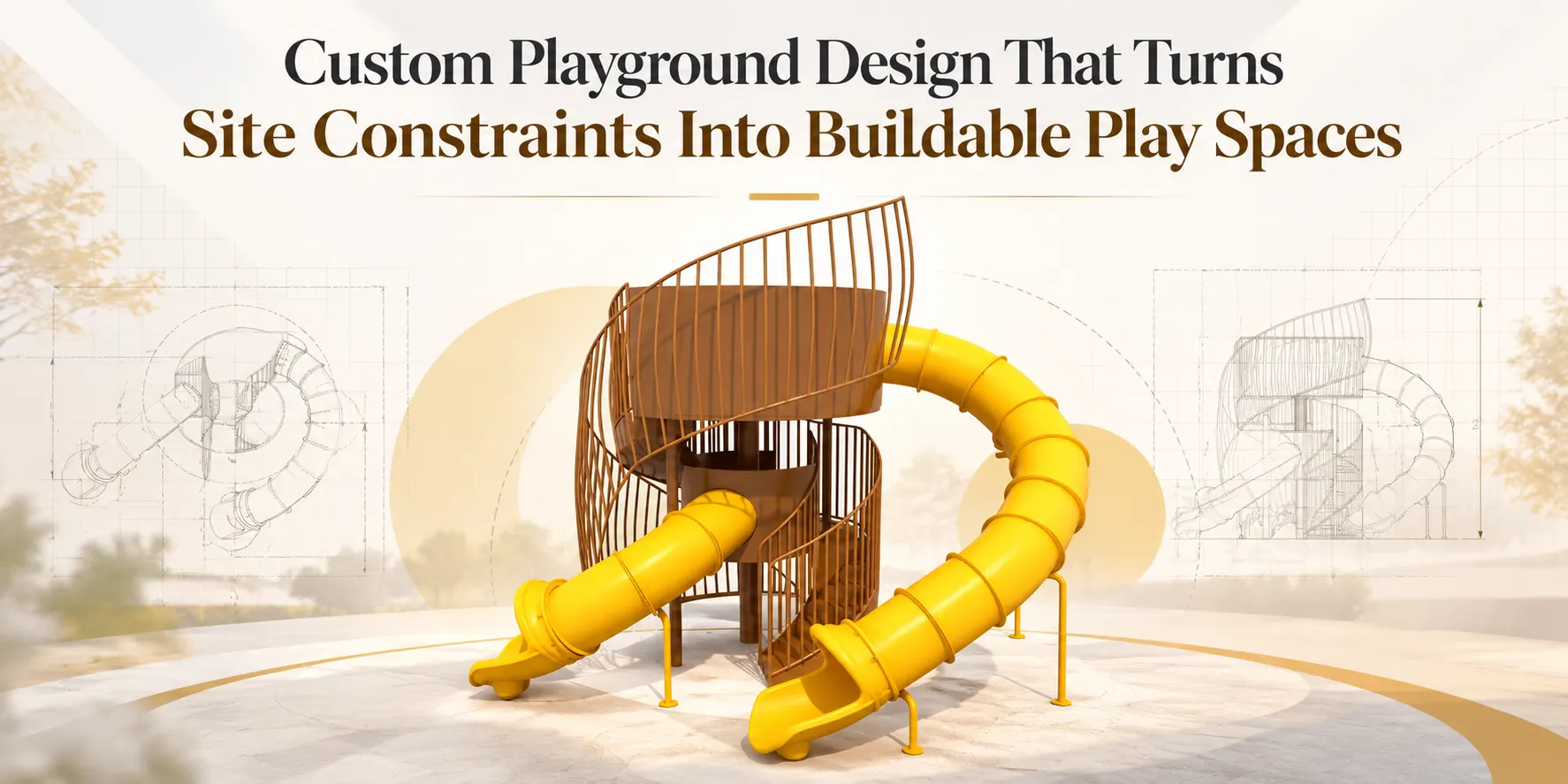
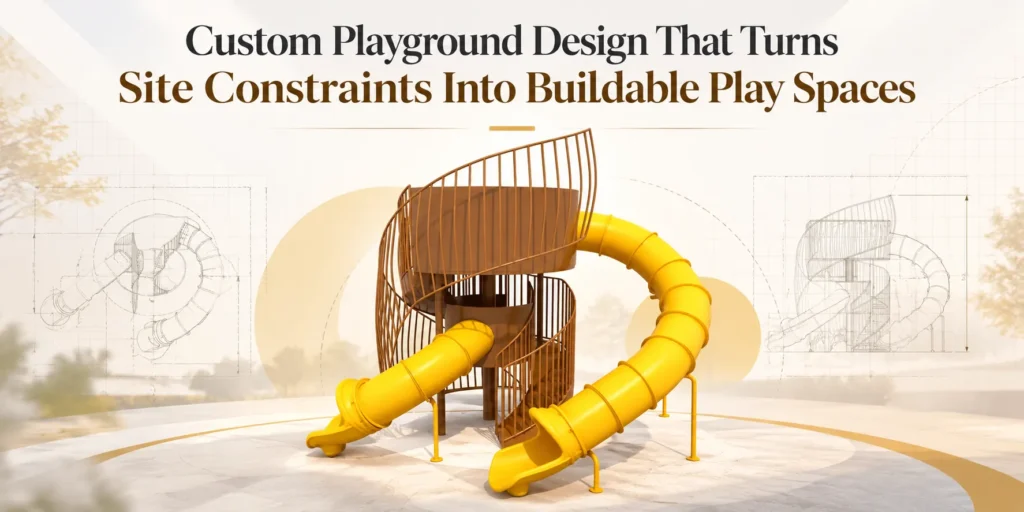
Sourcing a commercial playground that fits an exact site footprint, age group and budget is rarely solved by a catalogue model. Custom playground design is a made-to-specification service covering equipment configuration and site planning, from post and deck layouts to themed panels and surfacing. Playground supplier selection usually turns on how far a supplier can adapt standard platforms, what drawings and 3D files they issue, and how they handle inclusive play and planning constraints. The four sections below cover specification, process, constraints and RFQ evidence.
What Makes a Playground Design Truly Custom in a Procurement Context?
Custom, in procurement terms, means the parts that change use, cost and site fit are specified by you rather than fixed by a catalogue. Buyers can typically vary:
- Posts and deck heights, to match age group and fall-height rules
- Climbers, slides and towers, by combination, length and access route
- Panels, roofs and themed elements, by layout, colour and graphic insert
Modular design adapts a supplier’s standard platform family — same post diameter, same clamp system — so tooling stays shared and unit cost holds. Fully bespoke work introduces new moulds or fabrication drawings, which lifts cost and lead time.
Catalogue equipment ships as a fixed SKU. Custom specification adds site-plan drawings, a bill of materials by component, and a footprint check against surfacing and access zones. Importers, distributors and OEM buyers should test whether a supplier can adapt standard platforms, not only quote fixed models — a useful item for any playground equipment supplier checklist.
Inside the Custom Playground Design Process: From Site Brief to 3D Approval
Design work on a bespoke play structure usually advances through six decision points. Each one closes with something you can review, sign off, or reject before costs accumulate.
-
Intake and goal setting. You state the site type, user age band, capacity, budget band and target installation window. Output: a written brief you can compare against the quotation later.
-
Site and age-group review. Footprint, fall zones, level changes, drainage and access routes get checked against the brief. Expect a marked-up site plan and a note on any dimension that forces a change.
-
Concept sketches. Two or three layout options show tower positions, circulation and play value by age group. This is your cheapest point to redirect the scheme.
-
3D design visuals. 3D design software turns the chosen concept into scaled renderings and plan views, so non-technical stakeholders can see heights, sightlines and panel placement. Ask for file formats you can open without specialist software.
-
Collaborative revision. Rounds of comment on colours, themed elements, component swaps and access adaptations. Agree a revision limit in writing before this stage, or scope creep lands in the price.
-
Design freeze for quotation. Drawings, bill of materials and finishes lock, and pricing follows from the frozen version. Confirm the frozen drawing is the same revision referenced in the quotation.
Two approval gates matter most in procurement: the concept sign-off, which sets scope, and the design freeze, which sets price. Treat both as dated documents. A playground factory audit later will ask to see exactly this paper trail, and a playground supplier warranty dispute often turns on which revision was approved. Next, the site constraints that drive those revisions.
Planning Constraints That Shape Custom Playground Builds: Space, Budget, and Inclusive Play
Constrain the brief before custom playground design work starts. Each constraint changes what a supplier can quote:
- Footprint and location. A 12 m × 8 m infill plot cannot take a three-tower layout with fall zones; sloping ground adds retaining or platform height.
- Surfacing and access. Wet-pour, rubber tile, and loose-fill differ in depth and edge detail, so delivery routes and plant access need confirming early.
- Budget. A custom commercial build typically costs several times a flat-pack DIY playset, and priced designs usually cover engineering, not just steel.
- Phasing. Splitting into two tenders spreads spend but raises the risk of mismatched surfacing levels between phases.
- Inclusive play. Ramps, transfer stations, and ground-level panels widen the brief and change tower geometry, not just accessories.
State these as measurable clauses: footprint, unit count, surface type, phase dates. Numbers convert directly into RFQ evidence, which is where the next stage begins.
Turn the brief into evidence requests. Ask how many designers work in-house and which 3D tools they use, rather than accepting a sales drawing alone. State your required deliverable formats — STEP, DWG, GA drawings, scaled renders — so replies stay comparable. Then test component limits: post heights, tower combinations, slide lengths, panel printing methods. References with footprints, age groups and handover dates beat a gallery of unrelated builds; ask any OEM playground supplier for those specifics. Score replies against the five items below.
| Evidence item | Why it matters | Document to request |
|---|---|---|
| Design-studio capacity | Shows concepts and 3D work stay in-house, not subcontracted | Team structure, software list, revision policy |
| Component customisation limits | Sets realistic boundaries on post height, deck size, slide length | Dimensional range sheet or parameter list |
| 3D deliverable formats | Lets your engineers validate site fit before ordering | Sample STEP, DWG and GA drawing set |
| Comparable project references | Proves similar footprint, age group and phasing delivered | Two references with site photos and dates |
| Factory verification signals | Separates assemblers from full-process makers | Process photos, weld and coating records, test summaries |
About JQ Playground – playgroundsupplierguide.com
JQ Playground (Wenzhou Jiqi Amusement Equipment Co., Ltd.) is a children’s playground equipment manufacturer founded in 1993. The company provides design, customization, large-scale manufacturing, sales, installation guidance, and after-sales support for outdoor playgrounds, indoor playgrounds, soft play, water playgrounds, PE board playgrounds, kindergarten furniture, outdoor fitness equipment, pet playgrounds, and playground facilities. Approved company facts include 180+ employees, a large Wenzhou production base, 20+ production lines, 55 production machines, ISO/BSCI/EN1176/EN71/ASTM/CPC/CPSIC certification references, 100+ patents, free design support, OEM/ODM capability, trial installation before shipping, export experience, and one-year quality warranty.