Choosing a playground supplier is rarely just about comparing equipment prices. For project owners, distributors, contractors, schools, commercial developers, and government buyers, the more important question is whether the manufacturer can support the entire project—from early planning and customization to production, delivery, installation guidance, and long-term cooperation.
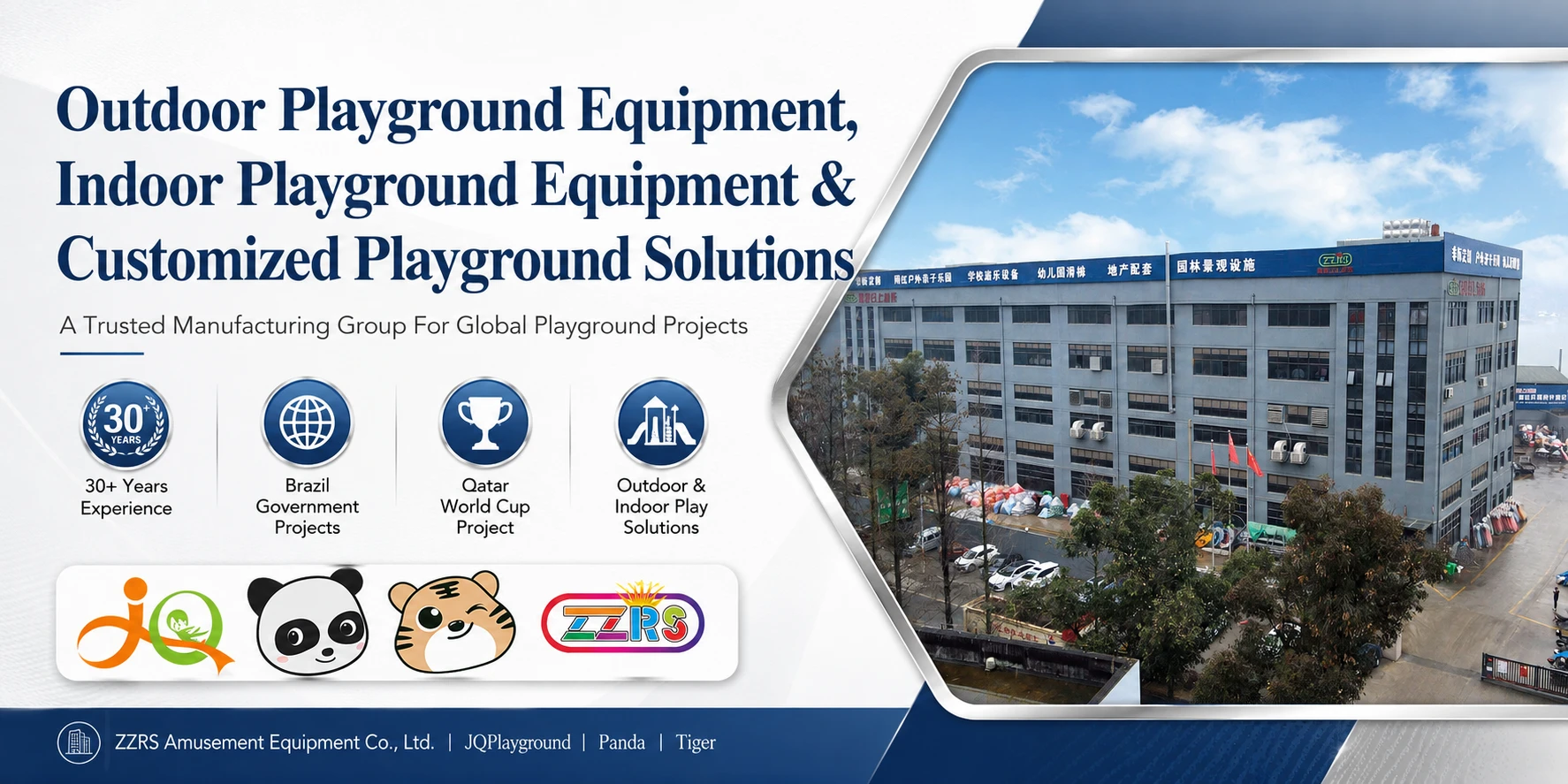
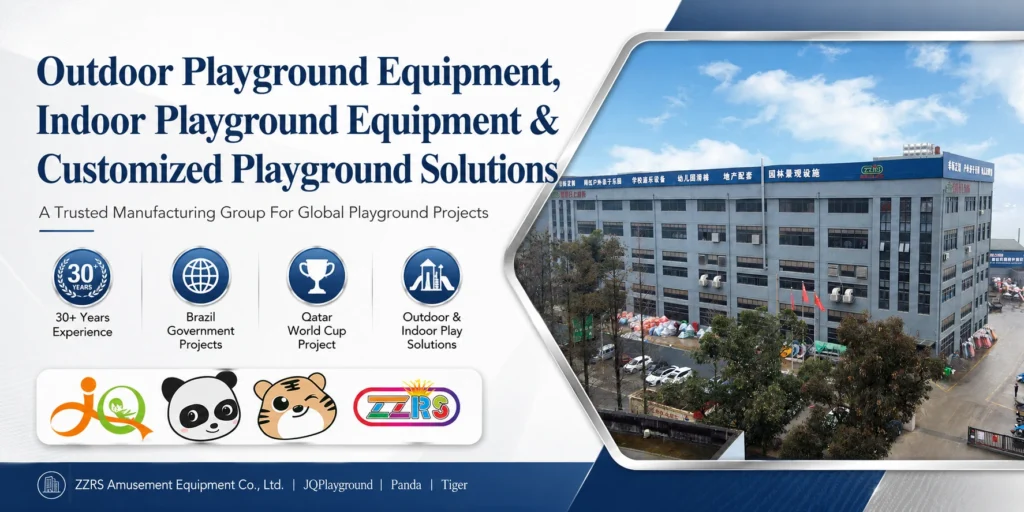
ZZRS Amusement Equipment Co., Ltd. has developed its manufacturing capabilities around exactly this challenge. With more than 30 years of industry experience, the group combines product development, customized design, large-scale manufacturing, international sales, and after-sales support to provide playground solutions for projects of different sizes and applications.
The group includes:
- ZZRS Amusement Equipment Co., Ltd. — Main Company
- Wenzhou Jiqi Amusement Equipment Co., Ltd. [JQPlayground] — Subsidiary
- Wenzhou Panda Amusement Equipment Co., Ltd. — Subsidiary
- Wenzhou Tiger Amusement Equipment Co., Ltd. — Subsidiary
Rather than operating as a simple equipment seller, the group is structured to support buyers who need a more complete sourcing and project-delivery system.
More Than Equipment Manufacturing
A playground project begins long before production starts.
The site may have unusual dimensions. The customer may need specific traffic capacity. A commercial operator may be focused on visual impact and repeat visits, while a school may place more emphasis on age-appropriate activities and efficient space usage. Government and public projects may introduce additional requirements for safety, durability, documentation, installation, and long-term maintenance.
This is why the company has developed its services around the complete playground project process.
Its core product portfolio includes outdoor playground equipment, indoor playground equipment, and customized playground solutions. These products can be applied in parks, residential communities, schools, commercial complexes, tourism projects, government facilities, and other public or commercial environments.
Outdoor Playground Equipment For High-Use Environments
Outdoor playground equipment is often expected to perform in demanding environments where equipment may face intensive daily use, changing weather conditions, and different site limitations.
For project buyers, selecting an outdoor playground therefore involves more than choosing a slide, climbing structure, or themed play unit.
The planning process may need to consider:
- Available site area
- User age groups
- Play capacity
- Equipment arrangement
- Circulation routes
- Project positioning
- Local safety requirements
- Installation conditions
- Visual identity
- Future maintenance
By combining project planning with manufacturing, the company can adapt equipment configurations according to the actual site instead of forcing every project into a fixed catalogue layout.
Indoor Playground Equipment Designed Around Space
Commercial indoor projects introduce a different set of challenges.
Indoor sites often have fixed columns, entrances, ceiling heights, fire-access routes, shopping-mall restrictions, or existing architectural structures. Every square meter can influence both visitor experience and the commercial value of the venue.
For this reason, indoor playground equipment should be planned as part of the space rather than treated as equipment that is simply placed inside a building.
The company supports customized indoor playground planning based on site conditions and project requirements, helping customers coordinate equipment layouts with available space and intended play functions. Its overall service system covers site planning, design, manufacturing, installation guidance, and after-sales support.
Customized Playground Solutions For Projects That Cannot Use Standard Designs
Not every playground should look the same.
A resort may want a landmark attraction. A residential development may require a compact community play area. A commercial center may prioritize a recognizable theme. A municipal project may need a larger combination of activities designed for heavy public use.
This is where customized playground solutions become particularly valuable.
Customization can begin with the physical site, but it can also involve the theme, equipment combination, activity flow, visual language, project scale, and manufacturing requirements.
The objective is not customization for decoration alone. Effective customization should connect the design to how the playground will actually be used.
A Manufacturing Base Built For Both Standard And Custom Projects
Strong project execution depends on what happens after the design is approved.
A supplier may create an attractive concept, but the real test begins when drawings enter production.
The company operates with a modern production base exceeding 60,000 square meters, supported by specialized workshops and production management systems. This manufacturing capacity allows the group to handle both larger production requirements and customized projects while maintaining consistency in manufacturing and delivery.
For international buyers, this distinction is important.
Large playground projects often involve many components, different materials, coordinated production schedules, packaging requirements, and installation planning. A supplier with stronger manufacturing integration can reduce the number of disconnected steps between concept approval and final shipment.
From Site Information To A Buildable Playground
One of the biggest differences between purchasing individual playground products and sourcing a complete playground project is the amount of coordination required.
A professional project workflow should connect several stages rather than treating them independently.
Stage One: Understanding The Project
Before recommending equipment, the supplier needs to understand what the buyer is trying to build.
Important information may include the site dimensions, application, target age group, expected capacity, project style, budget direction, local requirements, and installation conditions.
The better the initial project information, the more accurately the following design can respond to the site.
Stage Two: Planning The Playground
The next step is translating those requirements into an equipment and space concept.
Instead of focusing only on individual products, project planning considers how different play activities relate to each other and how visitors move through the playground.
For buyers evaluating several suppliers, this stage is particularly useful because it reveals whether a manufacturer understands the project as a whole or simply sends catalogue products.
Stage Three: Customizing The Design
Once the basic layout has been determined, selected equipment can be adjusted according to the site’s requirements.
This is especially important for customized playground solutions, where dimensions, configurations, themes, or activity combinations may need to change.
A commercially attractive concept must also remain practical to manufacture, transport, assemble, and maintain.
Stage Four: Manufacturing And Quality Control
The approved concept then enters production.
This is where production capacity, workshop management, material control, component coordination, and manufacturing consistency become critical.
The company’s factory and products have been associated with certification and audit systems including ISO, BSCI, Sedex, TÜV, ASTM, CE, and CPC, supporting projects that may need to consider different international market requirements.
Stage Five: Installation Guidance And After-Sales Support
Delivery is not necessarily the end of a playground project.
Installation information, product coordination, technical communication, and after-sales support can all affect whether the final playground matches the approved design.
The company’s service scope therefore extends beyond manufacturing to installation guidance and continued project support.
Experience Behind International And Government Projects
Large public and international projects place additional pressure on a manufacturer’s coordination ability.
Schedules may be tighter. Project communication may involve multiple parties. Equipment requirements may be more complex. Documentation and quality expectations can also be significantly higher than those of ordinary product purchases.
Over more than three decades of development, the company has accumulated experience serving different commercial and public-sector applications.
Among the representative projects highlighted by the company are government-related projects in Brazil and participation in FIFA World Cup Qatar 2022 related playground projects.
The Qatar experience is particularly relevant when evaluating the company’s ability to work with projects operating under higher international expectations. The supplied company information confirms participation in FIFA World Cup Qatar 2022 related projects as part of its broader government-project experience.
These projects are valuable not simply as portfolio references. They demonstrate why manufacturing experience matters when playground equipment moves from an ordinary product order into a coordinated project.
Why 30+ Years Of Experience Matters In Playground Procurement
Years in business alone do not automatically make a manufacturer suitable for every project.
However, long-term industry experience becomes meaningful when it has been converted into repeatable project processes.
With more than 30 years in the playground industry, the group has developed experience across design, customization, manufacturing, sales, and after-sales service.
For buyers, this can influence several practical areas.
Better Understanding Of Different Project Types
A school playground and a commercial attraction should not be approached in the same way.
Neither should an indoor family entertainment area, a residential community project, and a large public playground.
Experience across different applications helps a supplier identify these differences earlier in the project.
Stronger Communication Between Design And Production
A design is only useful when it can be manufactured successfully.
Experienced playground manufacturers understand that attractive concepts must eventually become real components, structures, packaging plans, and installation instructions.
Connecting these stages can make customization more practical.
Greater Flexibility For Project Buyers
International buyers do not all purchase in the same way.
Some need complete playground systems. Others may be distributors building local product ranges. Contractors may require equipment for a specific tender or development, while government buyers may focus on larger public projects.
The company’s project approach is designed to serve distributors, contractors, and government buyers rather than limiting its business to one purchasing model.
A Playground Supplier Should Help Buyers Make Better Decisions
For playgroundsupplierguide.com, evaluating suppliers should go beyond answering one question: “What products do they sell?”
A more useful supplier assessment asks:
Can the manufacturer understand the site?
Can it develop both standard and customized solutions?
Can its factory turn the design into consistent production?
Can it support larger project quantities?
Can it communicate through planning, manufacturing, shipment, and installation?
Can it adapt outdoor playground equipment, indoor playground equipment, and customized playground solutions to different applications?
These questions matter because the lowest quotation does not necessarily produce the lowest project cost.
Unexpected design changes, unsuitable dimensions, incomplete installation information, production delays, or poor coordination can all create costs after an order has already been placed.
A capable supplier should therefore reduce project uncertainty, not simply provide equipment.
Building Playground Projects Around The Customer, Not The Catalogue
The playground industry is moving increasingly toward differentiated environments.
Commercial operators want attractions that stand out. Developers want recreational spaces that support the identity of their projects. Schools and communities want safer, more engaging environments. Government buyers need solutions that can be implemented reliably at scale.
This makes the traditional catalogue-only sourcing model less suitable for many projects.
ZZRS Amusement Equipment Co., Ltd. and its subsidiaries approach playground manufacturing through a combination of project planning, production capability, customization, and service support.
For buyers sourcing outdoor playground equipment, indoor playground equipment, or customized playground solutions, the value of this structure is straightforward: one project can move from an initial site requirement toward a manufacturable and installable playground through a more connected process.
After more than 30 years in the industry, the group’s direction remains focused on a fundamental idea—good playground equipment should not merely fill a space.
It should make the space worth visiting.