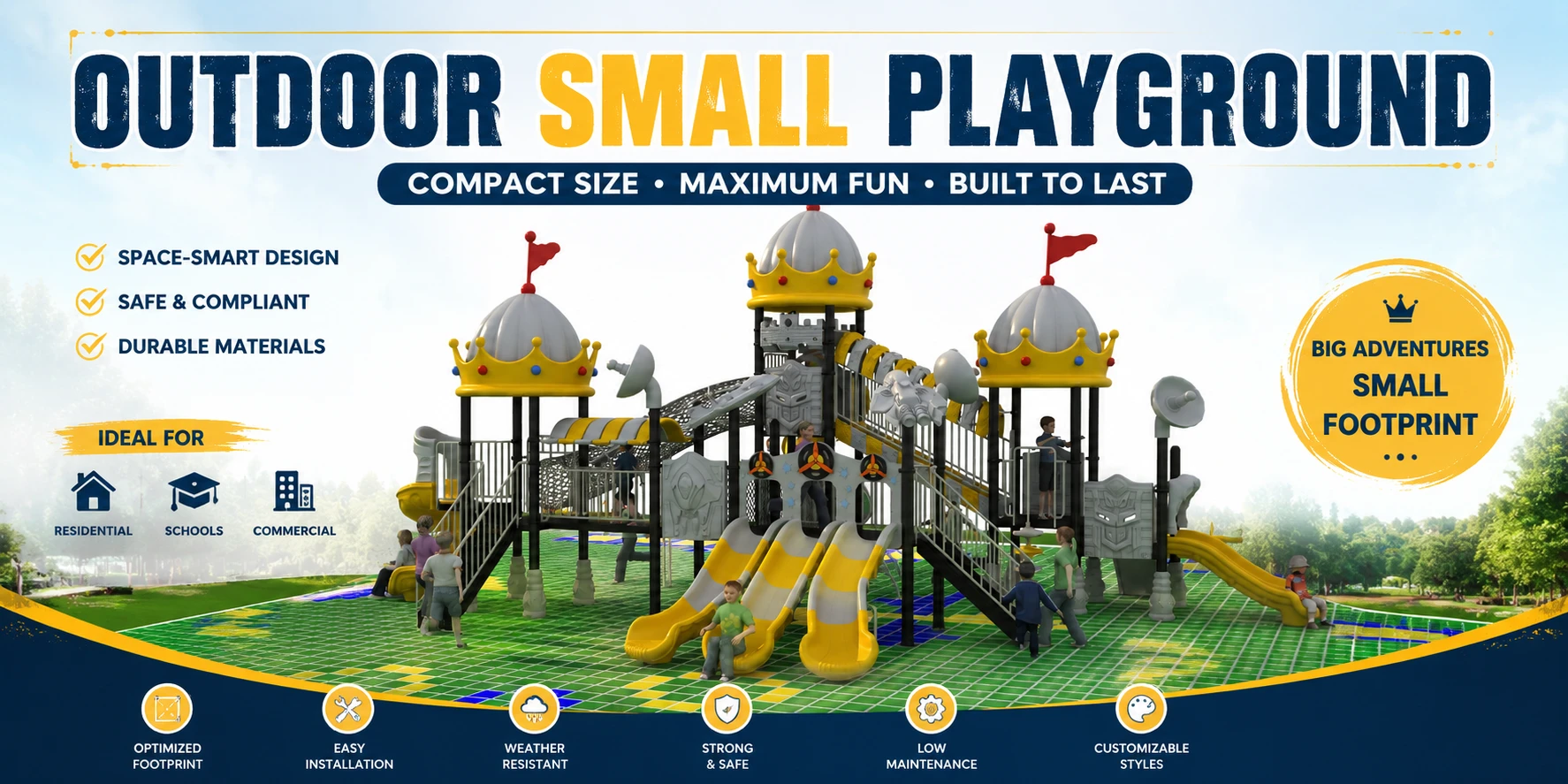
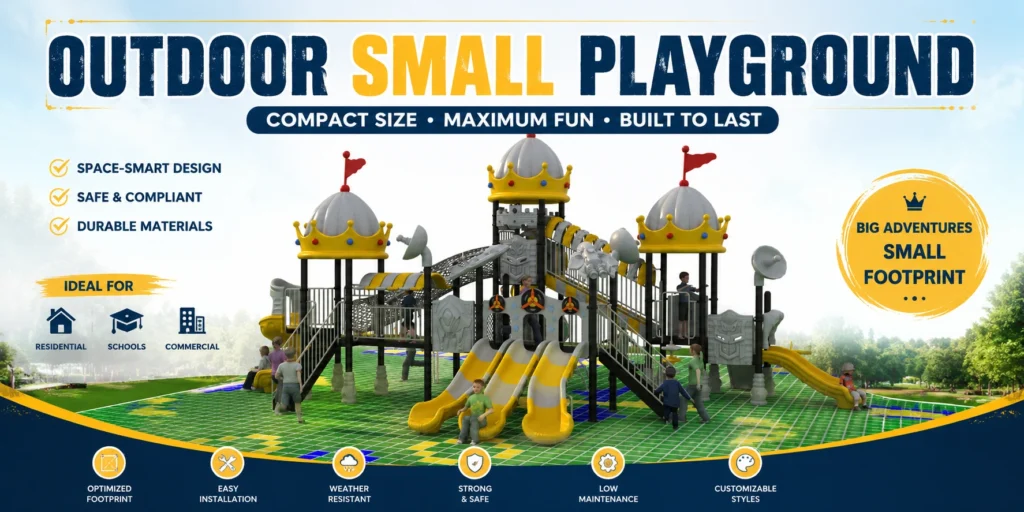
When you’re evaluating outdoor small playground options, the real test is whether a compact unit meets site limits, safety standards, and durability expectations at scale. Procurement teams juggle tight footprints, inspection timelines, and material specifications — often with limited physical space to negotiate with.
An outdoor small playground is a compact play structure designed for limited residential, school, or commercial spaces, typically combining swings, slides, and climbing elements in a small footprint.
Use this definition as a baseline in your playground supplier selection, then shift focus to supplier-side factors: dimensional accuracy, compliance documentation, and material grades.
Product Types and Categories for Outdoor Small Playground Sourcing
Retail category pages sort small playgrounds by compactness and style, and most suppliers mirror that taxonomy. Treat the five groups below as your playground equipment supplier checklist when shortlisting.
- Wooden playsets – 2.5–4 m footprints for ages 3–10. Choose cedar or pressure-treated pine and confirm knock-down packaging to keep container freight viable.
- Compact swing sets – space-saver A-frames with roughly 3 m swing arcs for ages 2–8. Galvanised steel fixings and bolt-together assembly cut on-site time.
- Space-saver structures – corner or wall-mounted towers under 2 m wide for ages 2–6. Modular builds allow OEM colour customisation without re-engineering.
- Toddler-specific units – low decks, short slides, wide steps for ages 1–4. HDPE panels resist splinters and reduce part count.
- Architectural/classic/rustic styles – design-led finishes command premium pricing, so verify material grades and finish specifications at RFQ stage.
Sizing, Configuration, and Material Specs for Compact Playground Units
Start with the stated footprint, then add clearance. A swing set’s true footprint roughly doubles once you allow for the swing arc: a 2.4 m beam needs about 4.8 m of rear clearance. Play towers need less open space, but always include the slide discharge zone in your site plan.
Material choice sets the maintenance cycle. Cedar resists rot but needs sealing every 2–3 years; pressure-treated wood is cheaper yet checks and splinters. Galvanised steel gives the best weight-to-durability balance, while HDPE holds colour without re-coating. During a playground factory audit, confirm zinc thickness and steel gauge on the spec sheet. Also verify per-bay weight limits and specify 200–300 mm of loose-fill surfacing under fall zones.
| Spec | Space-saver swing set | Play tower with slide |
|---|---|---|
| Frame footprint | 3.0 × 2.4 m | 2.0 × 1.8 m |
| Clearance needed | 4.8 m rear arc | 2.5 m slide discharge |
| Age range | 3–10 years | 2–8 years |
| Weight limit | 45–90 kg per bay | 50–70 kg per deck |
| Material watch | Beam deflection at hangers | HDPE UV stability |
That shortlist then feeds the buy-versus-build decision.
Buy vs Build Assessment for Small Playground Installations
Prefabricated units win on speed and predictable documentation; custom builds win on site fit and design flexibility. Your decision hinges on lead times, ground conditions, and local inspection requirements.
Buying a manufactured unit gives you factory-issued load calculations, material certifications, and installation drawings that can be submitted directly to the building control body. Custom structures transfer that documentation burden to your engineer or fabricator, which usually adds weeks to the programme.
When qualifying a supplier for a tender, request these as minimum evidence:
- Structural calculation sheets signed by a qualified engineer covering live loads, wind loads, and swing impact zones.
- Material certificates for timber treatment, galvanised steel thickness, or HDPE UV stabilisers.
- Foundation and anchoring details matched to your soil type and fall-height surfacing.
- A permit-ready drawing set showing dimensions, access paths, and boundary setbacks.
That evidence is the difference between a smooth inspection and a stalled installation. Use these criteria as your playground supplier comparison criteria when scoring bids.
RFQ Signals to Look for in Small Outdoor Playground Suppliers
Scan product listings before sending an RFQ. A well-named outdoor small playground listing states the footprint, age range, and configuration in the title. Vague names usually signal weak documentation.
Check three signals. Dimensional drawings: do they show swing arc clearance, anchor points, and fall zones? Material grades: galvanised steel thickness, HDPE density, or timber treatment method. Safety detail: anti-tip brackets, rounded edges, and gap measurements. Assembly complexity: can two installers handle it, or does the sequence require a crane?
Price range and MOQ reveal capability. A wide price band often indicates an OEM playground supplier willing to customise; a fixed price with a high MOQ signals standardised production. Check whether the product page lists colour, logo, or layout options.
Request these RFQ documents:
– Dimensioned installation drawings and torque specs
– Material grade certificates and treatment data
– Safety compliance test reports
– Load calculations for swing beams and platforms
Common Procurement Questions for Small Outdoor Playground Orders
Procurement teams raise the same four questions during RFQs. Here are the direct answers.
What clearance does an outdoor small playground really need?
Measure the swing arc, not just the unit footprint. A 2.4 m swing beam typically requires 4 m of front-to-back fall-zone clearance. Ask for a dimensioned fall-zone diagram before confirming site fit.
Which safety tests should compact equipment meet?
Request impact-attenuation data for surfacing and check that load-bearing parts align with your local standard. Flat-packed units must still include adequate anchoring points and edge protection.
Can compact units be shipped flat-packed?
Yes. Most space-saver models arrive knock-down. Confirm panel counts, and check whether the manufacturer offers playground spare parts support, since small fittings often go missing on site.
How long does installation take?
Two-person crews usually finish a small unit in 4-6 hours on a level base. During China playground supplier verification, ask whether holes come pre-drilled to cut site labour.
About JQ Playground – playgroundsupplierguide.com
JQ Playground (Wenzhou Jiqi Amusement Equipment Co., Ltd.) is a children’s playground equipment manufacturer founded in 1993. The company provides design, customization, large-scale manufacturing, sales, installation guidance, and after-sales support for outdoor playgrounds, indoor playgrounds, soft play, water playgrounds, PE board playgrounds, kindergarten furniture, outdoor fitness equipment, pet playgrounds, and playground facilities. Approved company facts include 180+ employees, a large Wenzhou production base, 20+ production lines, 55 production machines, ISO/BSCI/EN1176/EN71/ASTM/CPC/CPSIC certification references, 100+ patents, free design support, OEM/ODM capability, trial installation before shipping, export experience, and one-year quality warranty.