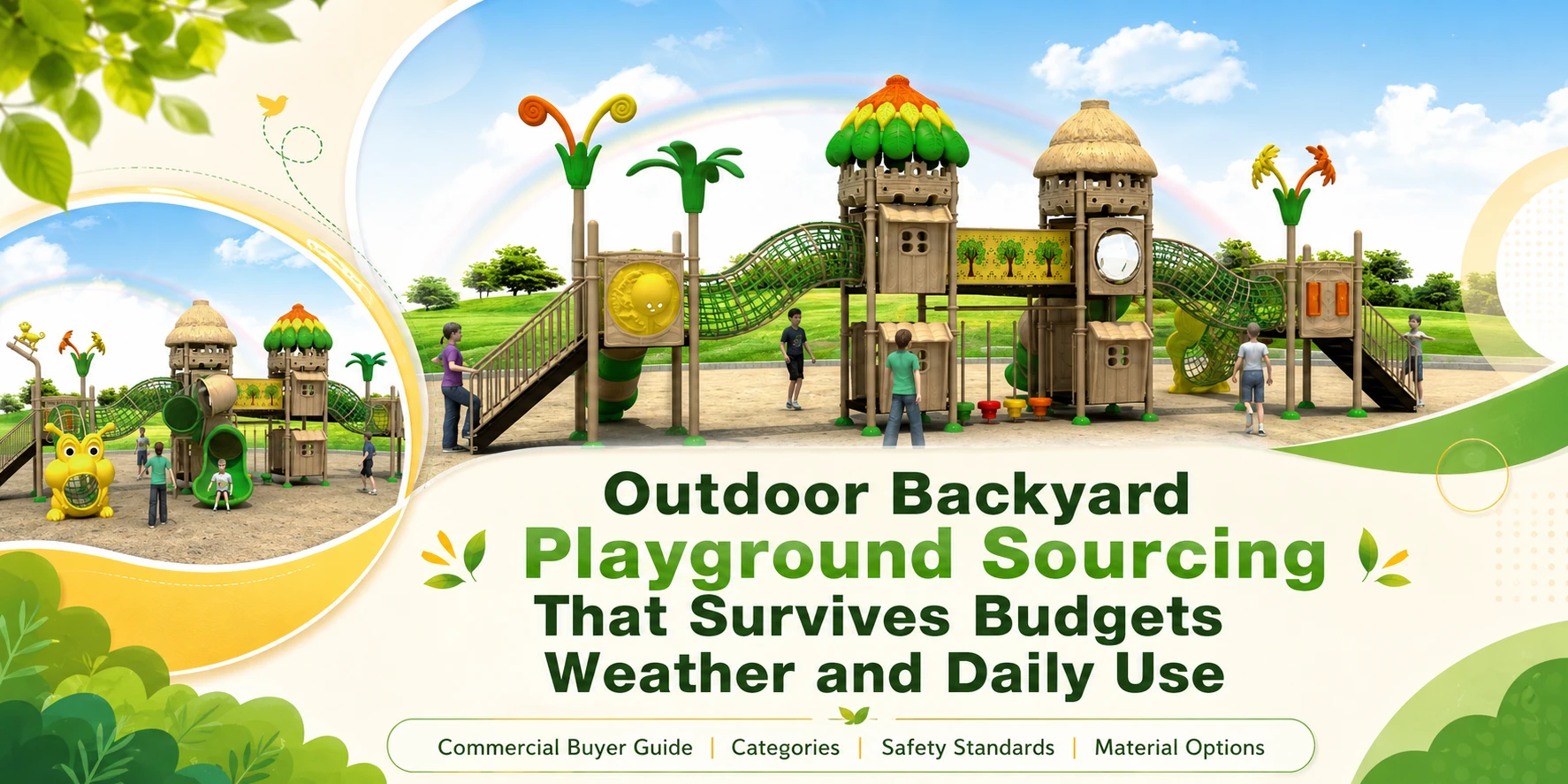
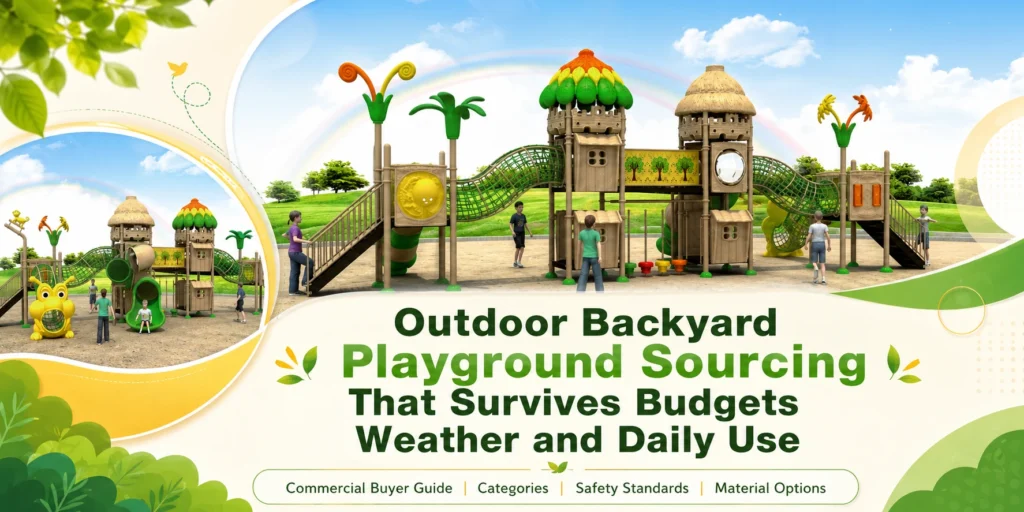
Commercial buyers sourcing outdoor backyard playground equipment must balance build quality, long-term durability, and project budgets. Low-cost options often fail within a season, while premium units can overrun allowances. You need structures that endure daily use across multiple installations without recurring repairs or safety gaps.
Outdoor backyard playground equipment refers to play structures designed for residential backyards but procured in bulk by importers, distributors, and contractors for projects.
This playground supplier guide outlines the main product categories you will encounter when shortlisting manufacturers, alongside selection criteria, safety compliance, and material options to help you make informed sourcing decisions.
Outdoor Backyard Playground Equipment Categories for Commercial Buyers
For commercial buyers, the product categories define both play value and procurement logistics. The five primary types — swing sets, climbing structures, slides, playhouses, and combination units — each carry distinct considerations for age range, space, installation, and bulk ordering.
- Swing sets suit ages 2–10. You need a fall zone of at least 2 m around the swing arc. Installation typically uses concrete footings. Commercially, minimum order quantities (MOQs) often start at 50 units. Packaging is flat-packed in export cartons (e.g., 1.2 m × 0.6 m × 0.3 m), so shipping dimensions directly affect container utilisation.
- Climbing structures target ages 4–12. They require 1.5–2.5 m of height clearance. Assembly involves bolting panels to A-frames. MOQs commonly hover around 100 sets. Cartons include corner guards; a 20‑foot container holds roughly 30 units.
- Slides are for ages 2–8. They need a clear run‑out zone of 1.5 m. Installation is straightforward — bolt to deck. MOQs are higher (200+), but slides can ship nested to save space. Verify piece weight for shipping compliance.
- Playhouses appeal to ages 2–6. Minimum floor area is 1.2 m × 1.2 m. Assembly is moderate (roof plus walls). MOQs range 50–100. Packaging is flat‑packed with shrink‑wrap to prevent surface scratches.
- Combination units cover ages 3–12. They demand 4 m × 3 m of space and a two‑person install. MOQs are lower (20–50) because cartons are larger; they ship palletised.
These categories also shape your RFQ. Add supplier questions about packaging dimensions, MOQ flexibility, and installation documentation to your playground RFQ supplier questions list.
Essential Supplier Selection Criteria for Backyard Playground Projects
Evaluating a playground supplier requires more than reviewing a catalogue. You need documented proof of production capability, product reliability, and ongoing support. Use this four-point checklist during supplier qualification.
1. Factory audit reports (ISO and social compliance). Request a current third-party audit certificate. ISO 9001 confirms quality management systems are in place. Social compliance audits (such as Sedex or SMETA) verify working conditions and labour practices. A supplier that cannot share a recent audit report risks inconsistent production and delivery delays. Always ask for the full report, not just the certificate cover page.
2. Warranty terms (parts vs. labour). Separate coverage for structural components, moving parts, and surface finishes is standard. A supplier offering a 5-year warranty on structural components indicates higher confidence in durability. Labour coverage is rarer; clarify whether replacement part costs are included but installation is not. Request the written warranty certificate before signing any agreement.
3. Lead times (sample and bulk). Sample lead times typically run 15–30 days; bulk orders often range from 45–75 days depending on container volume. Ask for a written lead time schedule that accounts for peak production periods (March–June). A supplier that cannot commit to specific sample delivery dates may struggle with bulk order reliability.
4. After-sales support (replacement parts and technical assistance). Confirm the supplier stocks spare parts for at least five years after production ends. Technical assistance via email or video call should be included, not charged separately. Ask for a spare parts catalogue and a response time commitment for urgent replacement requests.
A supplier that provides all four documents — audit report, warranty certificate, lead time schedule, and spare parts list — has passed the minimum bar for serious consideration in commercial playground procurement.
Safety Standards and Certifications to Verify in Backyard Playground Sourcing
Beyond supplier documentation, the next layer of verification is product safety certification. Three standards dominate commercial procurement: ASTM F1487 (United States), EN1176 (European Union), and AS 4685 (Australia). Each prescribes specific tests for impact zones, entrapment hazards, and structural integrity.
Request certified test reports before approving samples. Impact testing must show a critical fall height rating matched to the surfacing depth. Entrapment testing confirms no openings between 89mm and 230mm — the range that can trap a child’s head. Shear and crush points must also be verified.
Supplier credibility indicators include third-party lab certifications from TÜV, SGS, or Intertek. A manufacturer that supplies only a self-declared CE mark without a notified body report is a red flag in your playground supplier comparison criteria.
| Standard | Key Requirement | Buyer Action |
|---|---|---|
| ASTM F1487 (US) | Impact attenuation, entrapment, protrusion limits | Request full test report from accredited US lab |
| EN1176 (Europe) | Free height of fall, spacing, load-bearing | Verify EN1176 compliance certificate with lab ID |
| AS 4685 (Australia) | Similar to EN1176 with local climate adaptations | Cross-reference test lab accreditation to JAS-ANZ |
For a thorough commercial playground supplier guide, always request the test certificates by standard name and ask for the lab’s accreditation scope. If the supplier cannot produce a third-party report within two weeks, eliminate them from your shortlist.
Material Options for Outdoor Backyard Playgrounds: Durability and Maintenance
Beyond safety certification records, the material choice in an outdoor backyard playground determines long-term durability and maintenance costs. Each material family — wood, metal, and plastic — performs differently under sun, rain, and salt air. Sourcing decisions should match the material’s documented resistance to the specific project environment.
Wood (Cedar and Redwood)
Cedar and redwood are naturally rot-resistant, with cedar posts typically lasting 15–20 years in temperate climates. Redwood has similar longevity but costs roughly 15–20% more in bulk supply. Both require annual sealing or staining to prevent UV greying and moisture cracking. Without treatment, surface checking appears within two years. An OEM playground supplier should provide a kiln-dried moisture-content certificate (below 19%) and a treatment warranty for termite and fungal resistance. Maintenance frequency: one coat per year, rising to twice yearly in coastal or high-humidity zones.
Metal (Galvanised Steel and Aluminium)
Galvanised steel offers the highest structural strength, with typical yield strengths of 250–350 MPa for playground frames. Its zinc coating protects against corrosion for 20+ years in inland settings, but coastal salt spray reduces that to 8–12 years without additional coating. Aluminium is lighter (roughly one-third the weight of steel) and naturally corrosion-resistant, making it ideal for seaside projects. Request a salt-spray test report (ASTM B117, minimum 1,000 hours for steel, 2,000 hours for aluminium) and a galvanising thickness certificate (minimum 85 microns per EN ISO 1461). Metal requires little ongoing maintenance — inspect bolts and welds annually, touch up scratches.
Plastic (PE and HDPE)
Rotationally moulded PE slides and HDPE panels are the lowest-maintenance option. HDPE has built-in UV stabilisers that resist fading for 8–10 years in direct sun; PE typically lasts 5–7 years before colour changes. HDPE is also impact-resistant down to -40°C, important for cold-climate projects. Supplier documentation should include a UV stability test report (ISO 4892, 2,000-hour cycle) and a material data sheet with HDPE density (0.94–0.96 g/cm³) and flexural modulus. Cleaning is simply soap and water, but check that the supplier uses food-grade virgin HDPE, not recycled content that may crack.
Decision Matrix: Matching Material to Project Conditions
- Coastal (salt-laden air, high humidity) → Aluminium frames + HDPE panels. Accept galvanised steel only with a coastal-grade coating certificate (marine-grade zinc, 85+ microns).
- High-traffic (schools, public parks, rental fleets) → Galvanised steel structure with HDPE or PE components. Avoid wood — splintering and rot risk in continuous use.
- Cold climates (frequent freeze-thaw, -20°C winters) → HDPE panels (not PE) and aluminium or painted galvanised steel. Wood can crack if not sealed properly.
- Budget-sensitive (large-volume order, $5,000–$15,000 per unit) → Pressure-treated pine (not cedar) for structural wood, or galvanised steel with PE slides. Verify treatment certification (UC-4B for ground contact).
- Low-maintenance required (annual cost-saving priority) → 100% HDPE and aluminium combination. No painting, no sealing — only annual hardware inspection.
When evaluating an ODM playground supplier, ask for material certifications from the factory’s in-house lab or a third-party test house. Cross-check the UV and corrosion test durations against the expected service life in your climate zone.
About JQ Playground – playgroundsupplierguide.com
JQ Playground (Wenzhou Jiqi Amusement Equipment Co., Ltd.) is a children’s playground equipment manufacturer founded in 1993. The company provides design, customization, large-scale manufacturing, sales, installation guidance, and after-sales support for outdoor playgrounds, indoor playgrounds, soft play, water playgrounds, PE board playgrounds, kindergarten furniture, outdoor fitness equipment, pet playgrounds, and playground facilities. Approved company facts include 180+ employees, a large Wenzhou production base, 20+ production lines, 55 production machines, ISO/BSCI/EN1176/EN71/ASTM/CPC/CPSIC certification references, 100+ patents, free design support, OEM/ODM capability, trial installation before shipping, export experience, and one-year quality warranty.