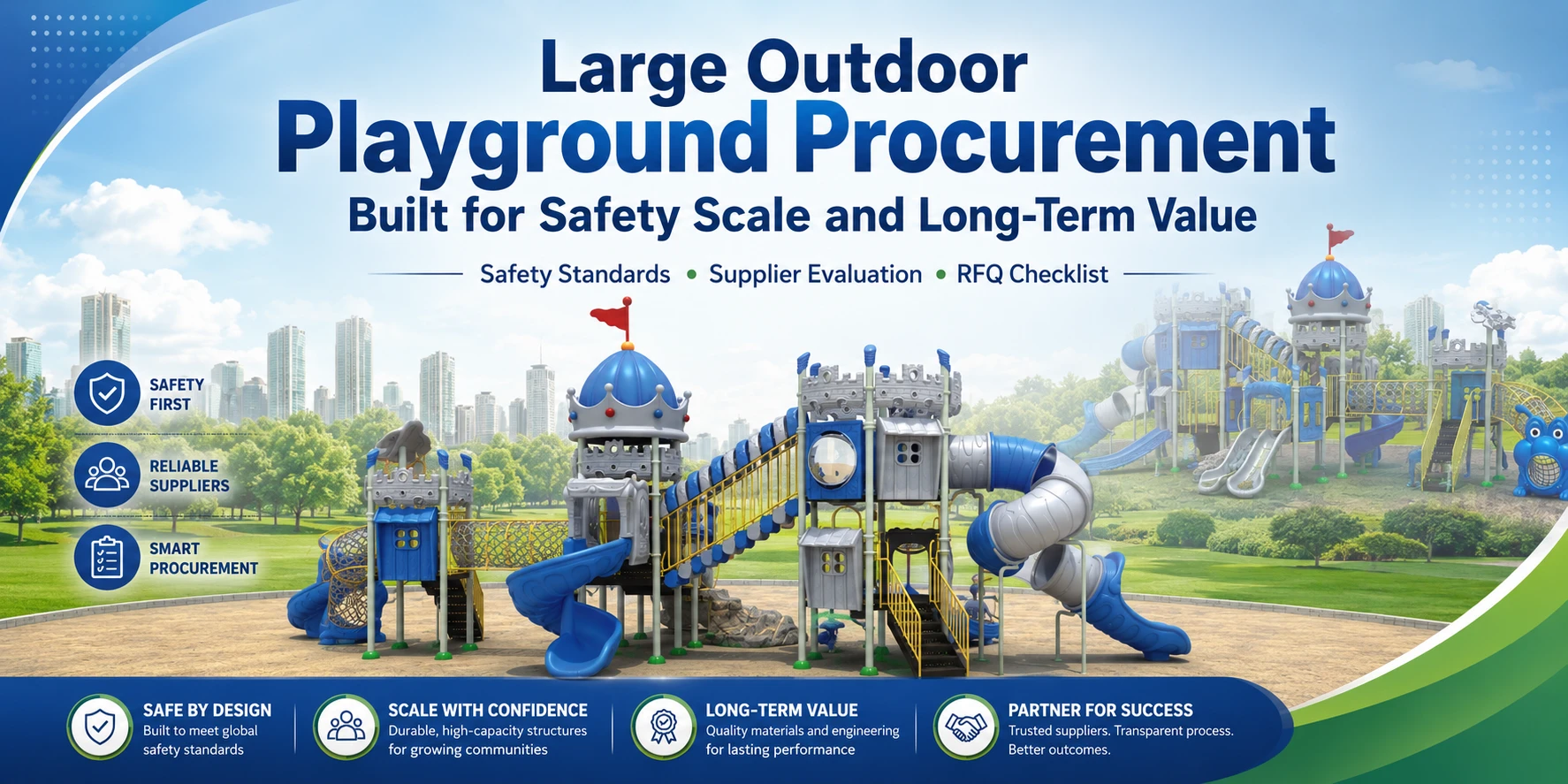
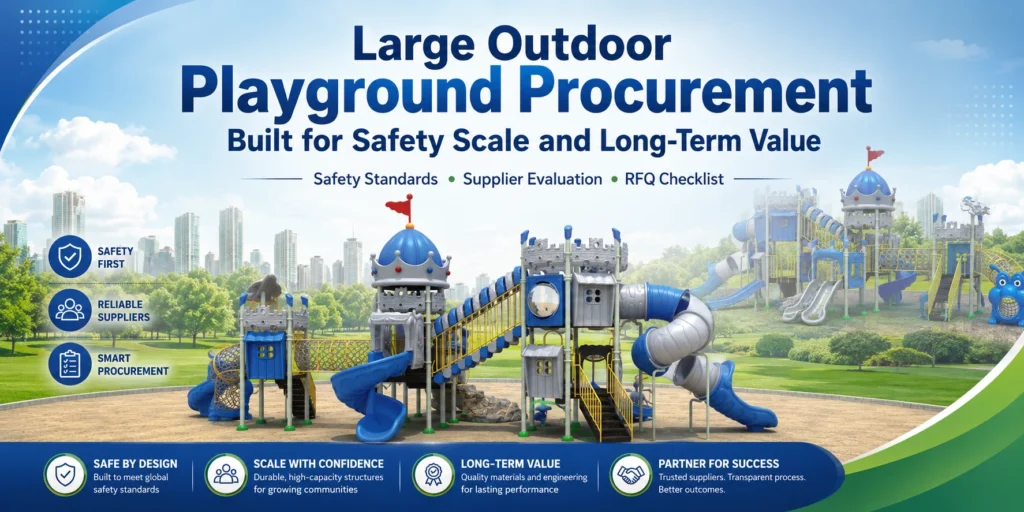
You are tasked with procuring a large outdoor playground for a school, park, or resort. The challenge is real: balancing safety standards, durability requirements, and tight project budgets across multiple supplier bids. One wrong specification can delay an entire installation by weeks.
A large outdoor playground is a commercial-grade play area typically exceeding 1,000 sq ft, designed for schools, parks, resorts, and public spaces. It features multi-station structures, engineered safety surfacing, and durable materials such as galvanised steel or rotomoulded plastic. These installations must comply with ASTM or EN1176 standards from the start.
This guide outlines critical specifications, supplier evaluation criteria, and a procurement checklist to help you make informed decisions during playground supplier selection. Read on for the key features that define these commercial spaces.
Key Features and Specifications That Define Large Outdoor Playgrounds for Commercial Use
Large outdoor playgrounds for commercial use typically occupy 1,000 to 10,000+ sq ft and serve schools, public parks, resorts, and community spaces. They are built for high-traffic daily use and must comply with ASTM F1487 (USA) and EN1176 (Europe) safety standards.
Key structural features include:
- Multi-tier play towers – 2–4 levels connected by bridges, slides, and climbing elements, supporting 50+ children simultaneously.
- Climbing nets and ropes – 3D web structures that meet fall height limits (typically 8–12 ft per ASTM F1292).
- Slides – straight, spiral, or tube types; length ranges from 4 to 20+ ft depending on available space.
- Swings – belt, bucket, inclusive (e.g., wheelchair-accessible) bays; require 2× the swing height in clearance zone.
Safety surfacing reduces impact severity and must match the equipment’s critical fall height. Below is a comparison of three common options:
| Surfacing Type | Approx. Cost per sq ft | Fall Height Rated | Maintenance |
|---|---|---|---|
| Poured-in-place rubber | £8–£15 | Up to 12 ft | Low – clean debris, minor repairs |
| Engineered wood fibre | £3–£6 | Up to 10 ft | High – top-up quarterly, remove contaminants |
| Artificial turf (with pad) | £6–£12 | Up to 8 ft | Moderate – brush, refill infill yearly |
Choose surfacing based on budget, traffic volume, and ADA/EN 1177 accessibility requirements. A playground equipment supplier checklist should verify that the chosen surface material is certified to the correct fall height for each play component.
Critical Supplier Evaluation Criteria for Large Outdoor Playground Equipment
Evaluating a playground supplier requires more than comparing prices. These six criteria determine whether your installation meets safety regulations, lasts through years of use, and fits your project timeline.
-
Certification compliance. Verify that all equipment meets ASTM F1487 (US), EN1176 (EU), or CSA Z614 (Canada) depending on your market. Request copies of current test reports from an accredited lab. Beware of counterfeit certification claims — always cross-check the certificate number with the issuing body.
-
Material quality. Standard commercial-grade playgrounds use galvanised steel for structural posts (minimum 3 mm wall thickness), rotomoulded polyethylene for decks, and aluminium for slides and handrails. In coastal or high-humidity environments, specify stainless steel hardware to prevent corrosion.
-
Warranty terms. Most suppliers offer 5–15 years on structural components, 3–5 years on moving parts like bearings and springs, and 2–3 years on plastic panels. Poorly structured warranties may require proof of annual inspections; confirm what voids coverage before signing.
-
Customisation capabilities. If you need specific colour palettes, shade structures, or inclusive play components, ask about the supplier’s flexibility. Larger manufacturers can modify design drawings within 2–4 weeks; smaller ones may rely on standard templates only.
-
Lead time. Expect 8–20 weeks from order confirmation to shipment, depending on complexity and current production load. Request a production schedule and delay penalties in the contract, especially for tender-driven projects with fixed openings.
-
After-sales support. Reliable suppliers provide installation manuals, spare parts availability for at least 10 years, and optional on-site supervision. A playground factory audit can verify that the factory stocks spare parts and maintains quality control records.
Prioritise suppliers who offer a thorough evaluation of your site conditions and surfacing requirements — this avoids later compliance surprises.
Comparing Leading Manufacturers of Large Outdoor Playgrounds
The commercial playground market includes several global manufacturers known for different strengths. Understanding their specialities helps you match supplier capability to project scale, budget, and compliance needs. Below is a comparison of four established suppliers frequently shortlisted by procurement teams.
| Supplier | Specialty | Export Markets | Typical Lead Time |
|---|---|---|---|
| JQ Playground | Custom-themed structures, modular steel towers, climbing nets | Asia, Middle East, Africa, Europe | 8–14 weeks |
| Playworld | Inclusive play systems, ADA-compliant designs, natural-looking units | North America, Europe, Australia | 12–18 weeks |
| Landscape Structures | Large multi-tower play structures, sensory play, shade solutions | North America, parts of Europe, Asia | 14–20 weeks |
| Kompan | Universal design concepts, fitness play, digital play elements | Europe, Middle East, Asia, Americas | 10–16 weeks |
Each supplier offers different levels of customisation. JQ Playground and Kompan tend to provide the most flexible customisation for large-scale projects, whereas Playworld and Landscape Structures excel in regional compliance for North American standards (ASTM, CPSC). Lead times vary depending on project complexity and current production load; always confirm with the supplier.
To shortlist, begin with your project’s primary requirement. If customisation and export to multiple regions are critical, prioritise suppliers with a demonstrated international track record. For projects requiring strict adherence to local safety codes, choose a manufacturer with proven compliance in your target market. Request recent project references of similar scale and complexity as your own.
RFQ Checklist and Supplier Verification for Large Outdoor Playgrounds
Once you have shortlisted potential suppliers, the next step is a structured RFQ process. Use this checklist to ensure every bid covers the critical details.
-
Required test reports. Request material certificates (e.g., galvanised steel thickness, HDPE UV stability), structural load tests (static and dynamic), and impact attenuation reports for the specified safety surfacing (EN 1177 or ASTM F1292). Ask for third-party lab evidence, not just a supplier declaration.
-
Installation support. Confirm whether the supplier provides on-site supervision, full installation crews, or a detailed installation manual. For large projects, factor in a site survey report and foundation drawings.
-
Spare parts availability. Ask for a list of replaceable components (swing chains, bearings, slides) and their lead times. A reputable supplier will stock spares for at least 10 years after purchase.
-
Payment terms. Typical commercial terms are 30% deposit with the order, 70% before shipment (or upon delivery for established OEM playground suppliers). Avoid 100% upfront payment. Clarify currency, bank charges, and letter of credit options.
-
MOQ ranges. Minimum order quantities vary by supplier. For a large outdoor playground, MOQs often start at 1–3 complete units or a set value (e.g., £15,000–£25,000). Confirm whether sample pieces or one-off custom designs are possible.
-
Factory audit questions. Ask: Do you hold ISO 9001 quality management certification? Can you provide client references for a playground of similar scale? Do you conduct in-house welding and rotomoulding, or outsource? Visit the factory or request a video tour to verify capacity.
Example RFQ template structure
A complete RFQ should include these sections:
- Project Info – site location, size, user age group, expected installation date.
- Specifications – preferred materials, colour scheme, play activities, safety surfacing type.
- Compliance – required standards (EN 1176, ASTM F1487), test reports required, inspection points.
- Services – installation scope, warranty terms (structural vs moving parts), training for maintenance staff.
- Pricing – unit price, tooling costs (if custom), delivery and insurance, payment schedule, validity period.
This structure helps you compare bids side by side and flags any ODM playground supplier that omits critical compliance details.
About JQ Playground – playgroundsupplierguide.com
JQ Playground (Wenzhou Jiqi Amusement Equipment Co., Ltd.) is a children’s playground equipment manufacturer founded in 1993. The company provides design, customization, large-scale manufacturing, sales, installation guidance, and after-sales support for outdoor playgrounds, indoor playgrounds, soft play, water playgrounds, PE board playgrounds, kindergarten furniture, outdoor fitness equipment, pet playgrounds, and playground facilities. Approved company facts include 180+ employees, a large Wenzhou production base, 20+ production lines, 55 production machines, ISO/BSCI/EN1176/EN71/ASTM/CPC/CPSIC certification references, 100+ patents, free design support, OEM/ODM capability, trial installation before shipping, export experience, and one-year quality warranty.