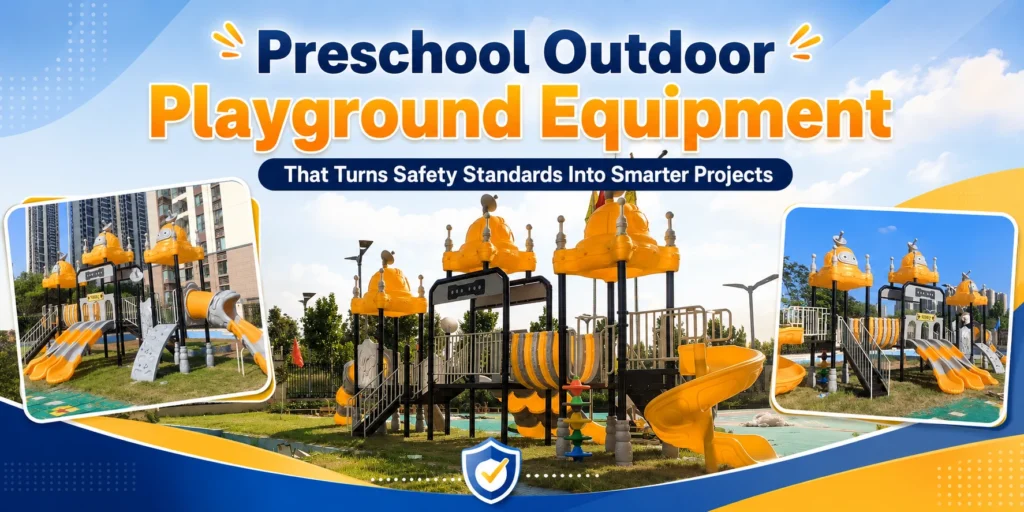
Sourcing safe, durable preschool playground equipment is rarely straightforward. Commercial buyers must balance durability against budget, verify compliance with multiple safety standards, and manage long lead times. One wrong supplier choice can delay a project or result in equipment that fails inspection within months.
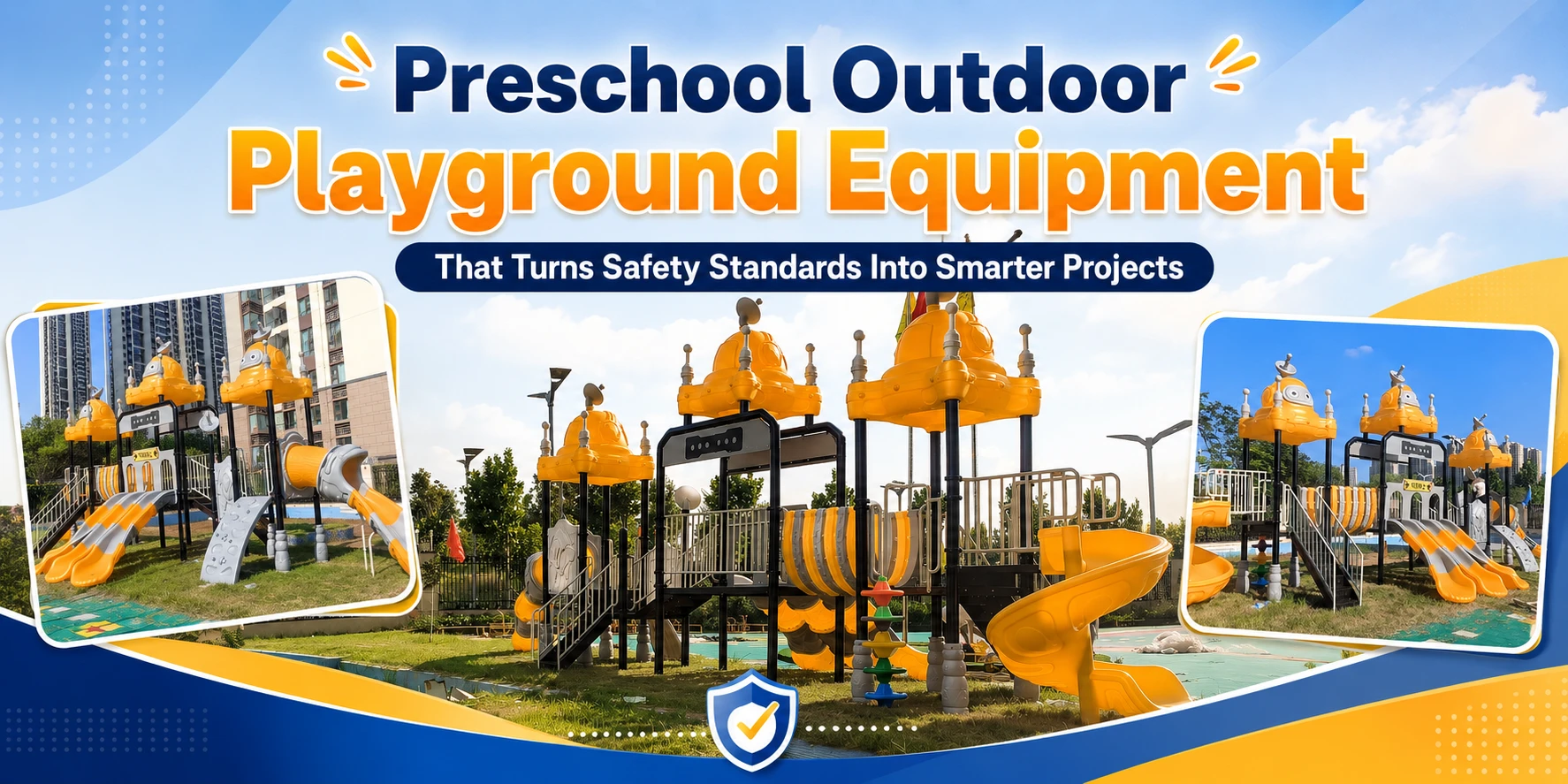
Preschool outdoor playground equipment refers to age-appropriate play structures designed for children aged 2–5, including slides, swings, climbers, and playhouses, built to strict safety standards.
This playground supplier guide covers essential product types, supplier evaluation criteria, customisation options, and logistics support to help procurement teams make informed decisions.
Key Product Types Covered by Safety Standards for Preschool Playgrounds
When selecting equipment for children aged 2–5, each product type has specific safety requirements defined by international standards. Here are the main categories and their key compliance points:
- Swings: Bucket swings (enclosed seat, low centre of gravity) are required for toddlers; belt swings are for older preschoolers. Standards mandate spacing between swing bays and a minimum clearance zone.
- Slides: Maximum slide height for preschool is typically 1.5 m (60 in). Tube slides must have ventilation gaps; straight slides need a flat run-out section of at least 300 mm.
- Climbers: Small arches, step platforms, and low ramps with handrails. Risk of falls is mitigated by limiting height to 1.2 m and ensuring platforms have guardrails.
- Playhouses: Must have low door thresholds, no sharp edges, and adequate drainage for outdoor use.
- Sandboxes: Require drainage, depth markers (max 300 mm sand), and lids to prevent animal contamination.
- Balance beams: Maximum height 200 mm; width at least 150 mm to allow stable footing.
All these product types fall under ASTM F1487 (US), EN 1176 (Europe), and CPSC guidelines. A key example: the critical fall height for preschool equipment is set at 1.5 m — any structure with a fall height above that must have impact-absorbing surfacing extending at least 1.8 m around the perimeter.
How to Evaluate Suppliers for Preschool Playground Equipment
Evaluating a preschool playground equipment supplier means verifying production capacity, certification validity, material quality, warranty terms, and after-sales support before any order. A structured checklist prevents costly mistakes from counterfeit certificates or hidden MOQs.
- Playground factory audit – Schedule a physical or virtual audit to inspect production lines, quality control checkpoints, and storage conditions. At minimum, confirm the factory holds ISO 9001 certification and practises batch traceability. Running production capacity below 500 units per month raises delivery risk.
- Third-party test reports – Demand compliance certificates from an accredited lab. For Europe, the key standard is EN 1176; for the US, ASTM F1487. In-house test results alone are insufficient — forged certification documents are a known risk in this market. Cross-reference the report number with the certifying body’s database.
- Material specifications – HDPE should be UV-stabilised with a minimum wall thickness of 4 mm. Galvanised steel must meet hot-dip standards (zinc coating ≥ 80 µm). Any wood treatment needs to be non-toxic and compliant with EN71‑3 for heavy metals. Ask for material data sheets before approving samples.
- Playground supplier warranty – Seek a minimum 5-year warranty on structural frames and 2 years on moving parts (swings, bearings). Check spare parts availability for at least 10 years after purchase. Hidden MOQs often appear in warranty clauses or after-sales documents — request a full quotation sheet with all numeric conditions up front.
- Decision point – If a supplier cannot provide a factory audit report or a third-party test certificate within two weeks, treat it as a warning sign.
Applying these criteria systematically reduces the chance of sourcing non-compliant or short-lived equipment.
Customization and OEM Capabilities for Commercial Playground Projects
Customisation lets you align a preschool playground with your specific site, brand, and inclusion goals. Most commercial suppliers offer two paths: adapting existing designs (custom colour, logo) or building from scratch via OEM. Understanding the process and costs prevents budget surprises.
Custom Design
Theme-based play sets – pirate ships, fairy-tale castles, nature trails – are popular with nurseries and daycare centres. You can request your school colours, mascot logo, and even branded signage on panels. Accessibility features (ADA compliance) now typically include ramps, transfer stations, and sensory panels for children with mobility or cognitive differences. Inclusive play elements such as ground-level activities and wide platforms avoid excluding anyone. A competent supplier provides 3D renderings and colour mock-ups before production begins.
OEM Process
OEM starts with your concept sketches or reference images. The supplier’s engineering team reviews structural feasibility, safety compliance (ASTM F1487 or EN1176), and material selection (durable HDPE, galvanised steel, treated timber). Design approval takes 2–4 weeks. Mould costs for plastic components can run £1,000–£5,000 per part, depending on complexity. Sample lead time is typically 2–3 weeks after mould completion. When comparing playground supplier comparison criteria, ask to see examples of past OEM projects and request a direct call with their engineers.
MOQ Considerations
Minimum order quantities for custom designs vary widely. Standard colour options often have no MOQ beyond a single play set. Full OEM with new moulds usually requires 10–50 units per component to amortise tooling. Some suppliers offer lower MOQs for repeat orders. A commercial playground supplier guide will note that mould ownership is negotiable – ensure you clarify this in the contract.
To verify a supplier’s engineering team, request photos of their in-house design studio, ask who holds the relevant safety certifications, and insist on a 3D rendering before committing to mould production. Typical project timelines from concept to shipment span 8–14 weeks for custom orders.
Lead Times, Installation, and After-Sales Support Considerations
Planning a playground project means factoring in lead times, installation logistics, and after-sales support – all of which affect your total cost and schedule.
Lead times
– Design phase: 2–4 weeks for standard products, up to 6 weeks for custom concepts
– Production: 4–8 weeks depending on order volume and material availability
– Shipping: 2–6 weeks for sea freight (FOB terms); air freight cuts this to 1–2 weeks but raises cost 3–5×. CIF terms shift insurance and freight risk to the supplier, reducing your administrative load.
– Customs clearance and weather delays can add 1–3 weeks; factor these into your project calendar. Industry benchmarks place total lead time for a typical preschool playground order at 10–16 weeks from design approval to arrival.
Installation services
– Supplier-provided installation: often bundled for larger projects, covering site preparation, anchoring, and safety surfacing. Verify that the team holds relevant certifications (e.g., IPEMA or EN 1176 training).
– Third-party installation: common for smaller budgets or remote locations. You must supply detailed assembly manuals and spare connection hardware. Cost ranges £1,000–£3,000 per structure depending on complexity.
– Both options require a site inspection prior to installation to confirm fall zones, access, and underground utilities.
After-sales support
– Spare parts availability: a reputable OEM playground supplier will maintain a stock of common spare parts for at least five years after purchase. Request a list of high-wear items (seats, swing chains, slide replacement sections) during procurement.
– Maintenance plans: annual safety inspections cost £200–£500 per structure. Part replacement cycles: swing seats every 2 years, slide sections every 5 years, wooden components every 3–5 years depending on coating quality.
– Long-term costs: budget 5–10% of initial equipment value per year for inspections, parts, and labour. Some suppliers offer extended maintenance contracts that reduce per-visit costs.
About JQ Playground – playgroundsupplierguide.com
JQ Playground (Wenzhou Jiqi Amusement Equipment Co., Ltd.) is a children’s playground equipment manufacturer founded in 1993. The company provides design, customization, large-scale manufacturing, sales, installation guidance, and after-sales support for outdoor playgrounds, indoor playgrounds, soft play, water playgrounds, PE board playgrounds, kindergarten furniture, outdoor fitness equipment, pet playgrounds, and playground facilities. Approved company facts include 180+ employees, a large Wenzhou production base, 20+ production lines, 55 production machines, ISO/BSCI/EN1176/EN71/ASTM/CPC/CPSIC certification references, 100+ patents, free design support, OEM/ODM capability, trial installation before shipping, export experience, and one-year quality warranty.